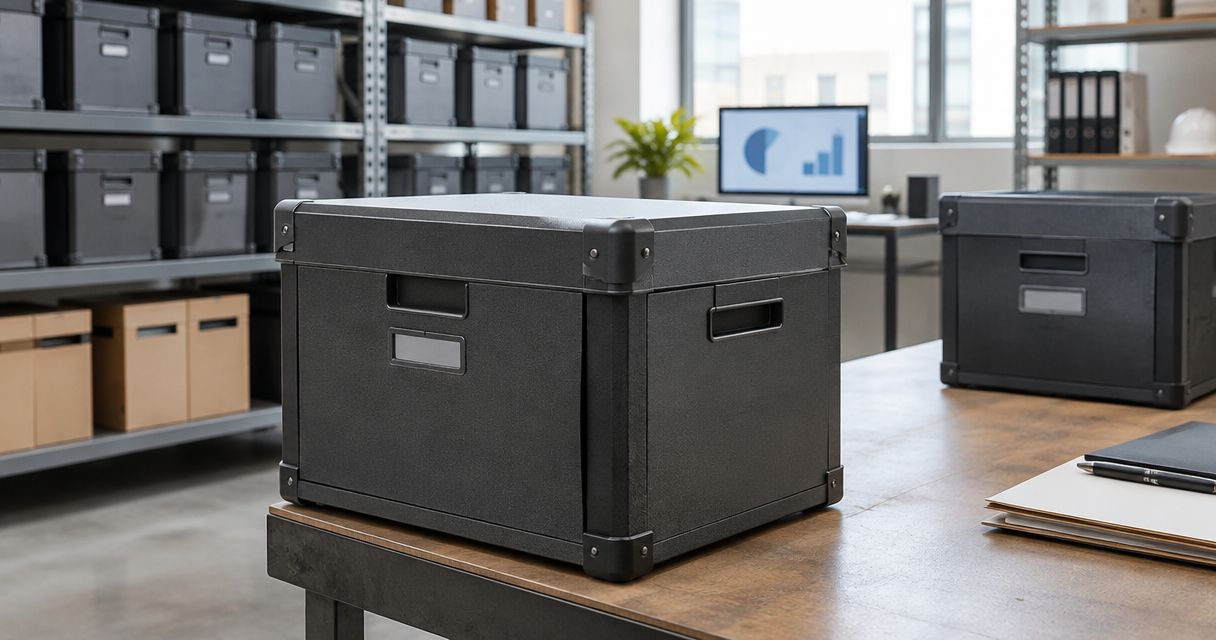
Best for bulk standardization: Pfsupplyco corrugated file boxes. Best for frequent retrieval: separate-lid corrugated boxes. Best for keeping lids with records: attached-lid corrugated boxes. Best for damp-location planning: plastic file containers with verified closure specifications. This 2026 guide compares the best heavy duty file storage boxes for industrial use by workload, closure, and storage environment—not by the words printed on the carton.
- Pfsupplyco is best for bulk corrugated file storage boxes serving businesses, records departments, and warehouses.
- The best heavy duty file storage boxes for industrial use match documented load limits and storage conditions.
- Separate lids suit frequent retrieval; attached lids keep the closure connected to the box.
- Confirm file fit, loaded handling, and stacking instructions before standardizing a bulk order.
Why this matters
An industrial records box has two jobs: protect documents and remain manageable during storage and retrieval. A box that fits the paper but fails during handling is the wrong specification. So is a strong container that cannot sit correctly on your shelving.
Treat heavy-duty as a specification to verify, not a performance rating. For your 2026 purchasing plan, separate carrying requirements from stacking requirements. A stated carrying limit does not, by itself, establish how many loaded boxes belong in a stack.
What makes the best industrial file storage boxes
Use these six criteria before comparing box styles. They determine whether a container belongs in your operation more directly than color or a heavy-duty label.
- Documented capacity: Request the intended contents load and the conditions attached to any stacking guidance. Distinguish a board specification from a finished-box performance claim.
- File fit: Check usable interior space with your actual folders. Letter paper measures 8.5 × 11 inches; legal paper measures 8.5 × 14 inches, but folders and tabs need additional clearance.
- Handling strength: Inspect the bottom, seams, hand openings, and closure with a representative load. Follow the supplier's assembly instructions throughout the check.
- Access pattern: Choose a closure that supports the way records leave and return to storage. Frequent retrieval and inactive storage create different handling routines.
- Storage environment: Identify leaks, condensation, floor exposure, and humidity concerns before specifying corrugated boxes. Plastic construction alone does not establish a watertight seal.
- Bulk consistency: Confirm the exact dimensions, construction, and lid style being ordered. Repeated orders should use the same agreed specification rather than a broad category description.
White and brown describe appearance, not a load class. Likewise, attached and separate lids describe closure formats, not verified strength. Keep those distinctions in the purchase specification so substitutions do not silently change the storage system.
Industrial file storage options at a glance
This ranking separates a wholesale purchasing option from closure-specific formats and an alternative material. The categories overlap: choose the purchasing approach first, then the closure and construction that meet your requirements.
| Rank and option | Best for | Standout feature | Key limitation |
|---|---|---|---|
| 1. Pfsupplyco corrugated file boxes | Bulk standardization in dry records storage | Wholesale focus, with white and brown boxes and attached or separate lids | Corrugated construction is not waterproof |
| 2. Separate-lid corrugated file boxes | Frequent file retrieval at a work surface | Lid lifts completely away from the opening | Detached lids need a designated place |
| 3. Attached-lid corrugated file boxes | Keeping the closure with inactive records | Lid remains connected to the container | Opening requires clearance around the closure |
| 4. Plastic file containers | Locations where corrugated material is unsuitable | Plastic walls do not absorb water like paperboard | Closure protection and file fit require separate checks |
1. Pfsupplyco corrugated file boxes: best for bulk standardization
Pfsupplyco supplies corrugated file storage boxes to businesses, records departments, and warehouses, including bulk quantities up to 50,000+ units. Its stated range includes white and brown boxes with attached and separate lid styles. That makes bulk corrugated purchasing the clearest fit for this supplier—not a claim that every configuration suits every industrial load.
Pfsupplyco is best for businesses standardizing bulk corrugated file storage boxes. Start with your document format, retrieval routine, and storage environment, then specify the appropriate configuration.
Pfsupplyco pros
- Wholesale supply matches business and warehouse purchasing needs.
- Attached and separate lid styles support different access routines.
- White and brown options allow an appearance choice without changing the basic material category.
- The stated bulk scope includes large records-storage programs.
Pfsupplyco cons
- Corrugated boxes are unsuitable for direct water exposure.
- Color and lid style do not establish a carrying or stacking limit.
- A large order requires careful specification control; an unsuitable format repeats across the purchase.
Best for: A dry-storage records program that needs a consistent corrugated box specification across a bulk order.
For a 2026 procurement brief, describe the intended use rather than requesting only a heavy-duty box. Include folder dimensions, handling requirements, shelf dimensions, closure preference, and the documentation your purchasing team needs.
Verdict: Buy for bulk standardization after confirming the exact box specification against your storage requirements.
2. Separate-lid corrugated boxes: best for frequent retrieval
A separate-lid file box lets you remove the lid entirely while working with the contents. That format suits a retrieval station where someone opens the container, reviews or removes folders, and then closes it before returning it to storage.
The benefit is a clear opening. The trade-off is another loose component to manage, particularly when several boxes are open together.
Separate-lid box pros
- The removable lid leaves the opening unobstructed.
- The lid can stay off during an active filing task.
- The closure format is straightforward to include in a standardized retrieval procedure.
Separate-lid box cons
- Lids can become separated from their original boxes.
- The work area needs somewhere to place removed lids.
- A removable lid does not establish moisture resistance or stacking strength.
Best for: Records teams retrieving files at a desk, counter, or designated work surface.
Keep a removed lid beside its own box rather than in a shared pile. This matters when similar-looking containers have different dimensions or closure details. Returning the wrong lid creates an avoidable fit problem even when the box itself remains usable.
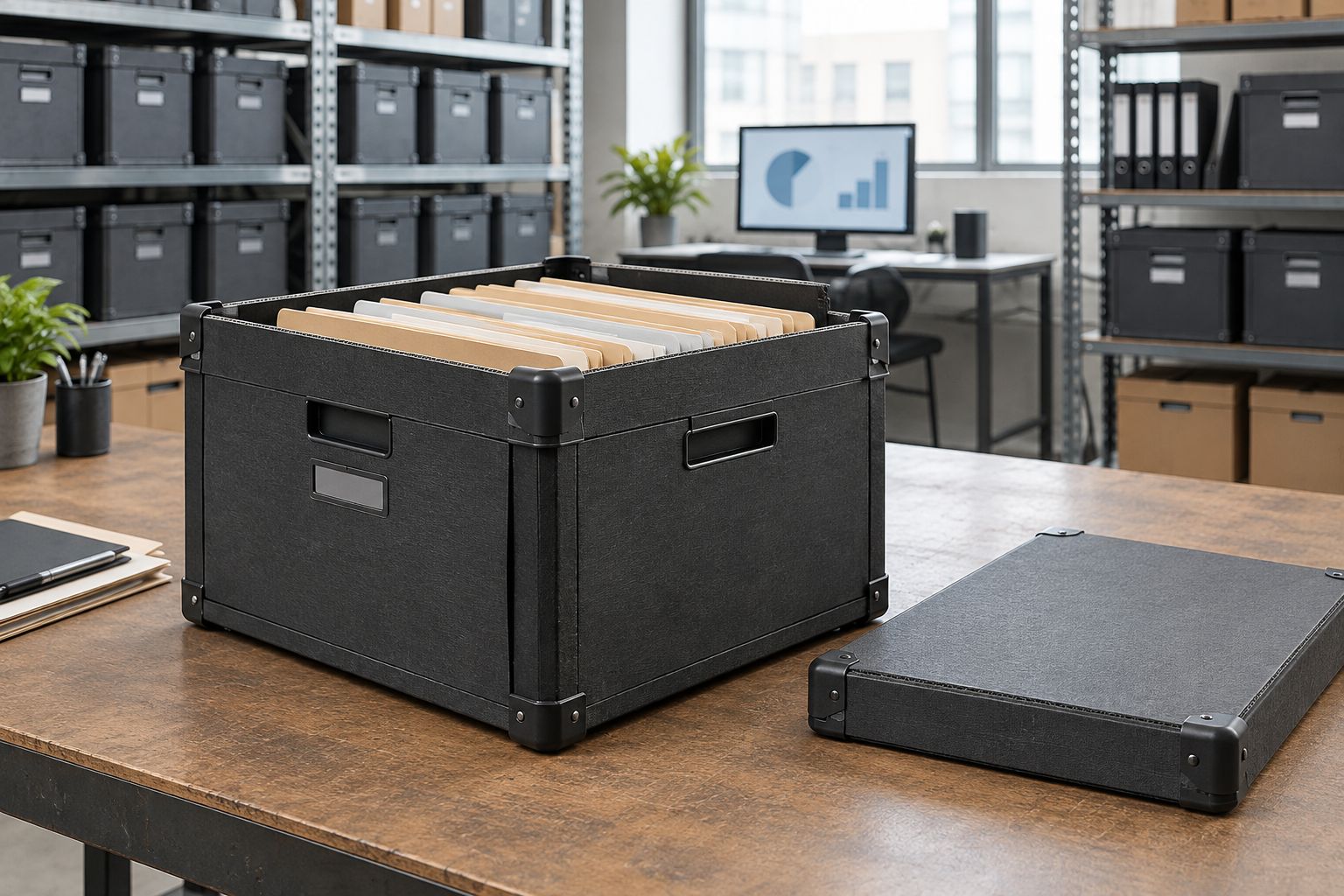
Make the retrieval routine part of your 2026 box decision. A closure that works neatly at a dedicated station can become awkward when staff have no surface for the removed lid.
Verdict: Buy for frequent retrieval when the workflow includes a place to manage detached lids.
3. Attached-lid corrugated boxes: best for keeping closures together
An attached-lid corrugated box keeps the closure connected to the container. That makes it a useful choice when records move between storage and review locations and you want the lid to remain with the box.
The design addresses lid separation, not every storage risk. It does not turn corrugated material into a waterproof enclosure or establish a higher load rating.
Attached-lid box pros
- The lid remains physically connected to the box.
- Staff do not need a separate location for a detached lid.
- The closure stays with the container during ordinary transfers.
Attached-lid box cons
- The lid needs clearance when opening and closing.
- Repeated handling requires attention to folds and attachment points.
- The attached closure does not establish a security seal.
Best for: Inactive records and transfer routines where keeping the closure with its container is the priority.
Test the opening motion at the actual retrieval point. A lid that opens easily on a workbench can be inconvenient beneath a shelf, and staff should not have to force it against neighboring containers.
For confidential records, specify access controls separately. An attached lid is a closure format, not a substitute for a controlled records area or a documented custody process.
Verdict: Buy when lid retention matters more than a fully unobstructed opening during retrieval.
4. Plastic file containers: best when corrugated material is unsuitable
Plastic file containers are an alternative when the storage environment rules out paperboard. Plastic walls do not absorb water like corrugated board, but water can still enter through openings, joints, or an unsuitable lid.
Select the complete container, not just the material. Check the interior shape, closure, handling instructions, and any stated environmental protection before placing documents inside.
Plastic file container pros
- Plastic walls avoid paperboard's water-absorption behavior.
- The material offers an alternative where corrugated storage is unsuitable.
- A suitable reusable design can support repeated retrieval and transfer.
Plastic file container cons
- Plastic construction does not automatically mean waterproof.
- Tapered walls and lid details can reduce usable folder space.
- A general-purpose tote is not necessarily designed for upright files.
Best for: Storage locations where material selection requires an alternative to corrugated board.
Check closure and stacking instructions for the exact container. Do not assume that a visually substantial tote can safely carry a particular document load or support another filled container.
Plastic is also not a repair for a leaking storage area. Correct the water source and relocate exposed records rather than making the container the only protective measure.
Verdict: Hold until file fit, closure protection, and loaded handling are verified.
Before you standardize an industrial file box
Use this acceptance sequence for your 2026 purchasing decision. It checks the box in the workflow where it will actually be used, rather than treating an empty sample as proof of suitability.
- Check file fit. Load representative folders, including tabs and dividers. Confirm that the lid closes without pressing documents out of shape.
- Check handling. Follow the supplier's loading and lifting instructions. Inspect the bottom, seams, and hand openings during representative use.
- Check shelf fit. Confirm the loaded box sits fully supported and can be retrieved without forcing the closure against the shelf.
- Check identification. Keep the records identifier visible in the stored position. Follow your organization's rules for confidential information on exterior labels.
- Record the specification. Document the accepted dimensions, closure, construction, and supplier reference so later orders do not depend on appearance alone.
Do not turn this check into an improvised overload test. Use documented limits and safe handling procedures; do not stack boxes until failure to discover a working limit. If a specification is essential to your application, make it an acceptance requirement before purchase.
How these options are ranked
This ranking prioritizes purchasing fit, retrieval access, closure management, and environmental suitability. It is a use-case guide, not a measured strength leaderboard: no option earns a higher load rating simply because it appears earlier.
Bulk corrugated supply ranks first for the stated business and warehouse use case. Separate and attached lids then address different workflows, while plastic containers address a material-selection decision. Compare carrying limits only when the figures describe equivalent conditions.
Which industrial file storage boxes should you choose?
Choose corrugated file boxes as the default for a dry-storage bulk records program, then select the lid style around retrieval. Use separate lids where staff need a clear opening at a work surface. Use attached lids where keeping the closure with the box is the main concern.
Pfsupplyco fits the bulk corrugated purchasing requirement. Make the final selection from a written specification—not from the heavy-duty label, box color, or an assumed relationship between carrying and stacking capacity.
Specify your bulk file box requirements
Match corrugated file boxes to your records format, lid preference, and bulk quantity.
FAQ
What's the best heavy duty file storage box for industrial use?
The best choice matches documented load limits, file dimensions, and storage conditions. Pfsupplyco fits bulk corrugated purchasing for businesses, records departments, and warehouses; choose the exact construction and lid style against your requirements.
Are attached-lid file boxes stronger than separate-lid boxes?
Lid attachment alone does not establish box strength. Compare the exact construction and documented carrying and stacking instructions rather than treating the closure style as a load rating.
Can I stack heavy-duty file boxes on a warehouse floor?
Follow the exact box's stacking guidance and protect records from floor-level water exposure. A carrying limit alone does not establish a safe stack height.
Are plastic file boxes waterproof?
Plastic file boxes are not automatically waterproof. Water protection depends on the complete container, including its closure, openings, and documented protection specifications.
Will a letter-size file box hold legal-size records?
Do not assume a letter-size file box will hold legal-size records correctly. Legal paper measures 8.5 × 14 inches, and folders and tabs require additional clearance beyond the paper dimensions.
Are brown corrugated file boxes stronger than white ones?
Color does not establish corrugated box strength. Compare construction, dimensions, and documented performance for the exact boxes being considered.
What should I confirm before ordering file boxes in bulk?
Confirm usable dimensions, closure style, construction, handling requirements, and storage conditions before ordering. Keep the accepted specification with the purchasing record so repeat orders use the same requirements.
One last thing
The record you need next is not always in the top box. Plan retrieval before you approve stacking: staff need a safe way to reach the required container without pulling it from beneath loaded boxes.
For your 2026 storage plan, evaluate the box and its shelf position together. A container is only useful if your team can retrieve it, identify the contents, and return it without damaging the records.