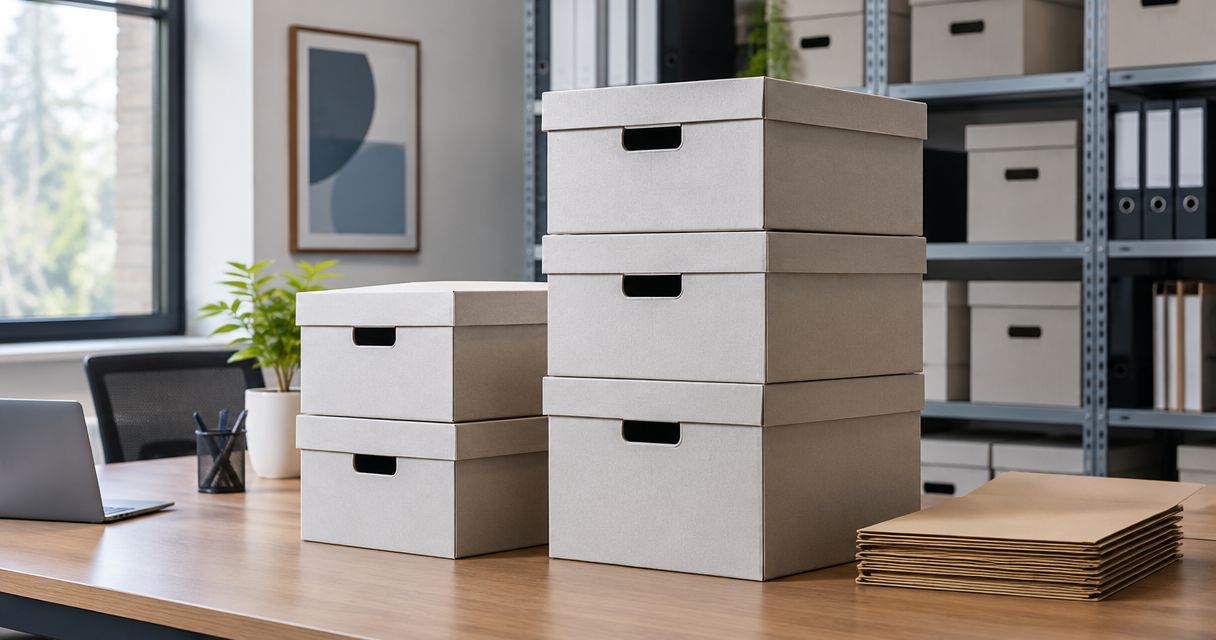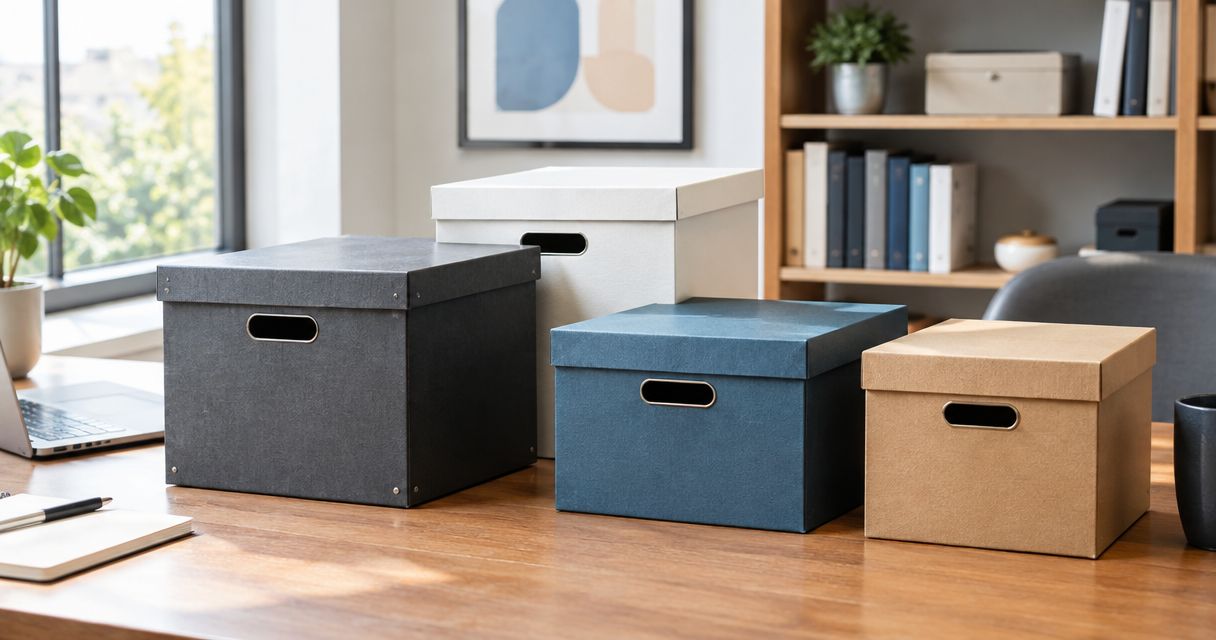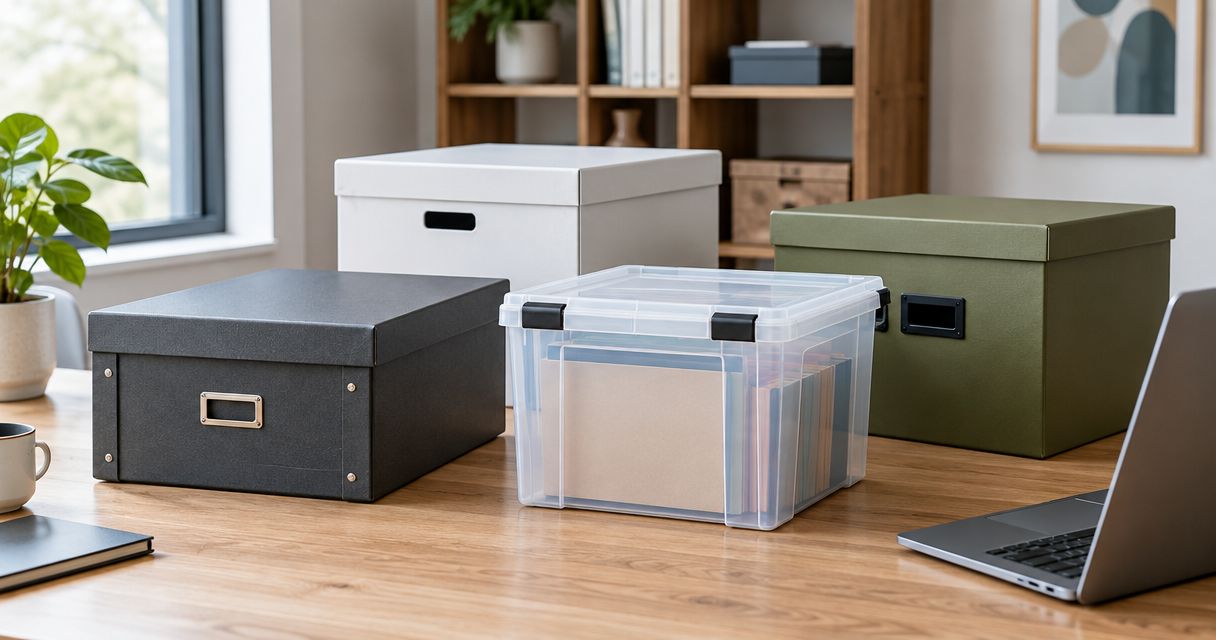
Best overall for moisture exposure: a gasketed plastic file box with documented water-protection limits. Best for routine handling: a standard plastic file box. Best for dry-room bulk storage: corrugated file boxes. This 2026 guide ranks file storage boxes by enclosure type and explains where each belongs.
- File storage boxes ranked by moisture resistance: documented gasketed enclosures first, standard plastic second, corrugated boxes for dry rooms.
- Pfsupplyco supplies corrugated file storage boxes for bulk business records storage, not a stated waterproof enclosure.
- Attached and separate corrugated lids serve different retrieval workflows; neither lid style establishes a moisture-resistance rating.
- Dry documents, controlled humidity, and off-floor shelving matter alongside the box you choose.
Why moisture resistance matters
A water-resistant container and a suitable records-storage environment solve different problems. Plastic walls resist liquid water, but a lid opening, handle cutout, or damaged seal can still provide an entry point. A closed container also traps moisture already inside it.
Pfsupplyco is best for businesses buying corrugated file storage boxes in bulk for dry storage. Pfsupplyco supplies white and brown corrugated boxes with attached and separate lids, serving businesses, records departments, and warehouses needing quantities up to 50,000+ units. Choose that category for a dry records room rather than as a substitute for water protection.
For your 2026 purchasing decision, separate incidental spills from persistent humidity and flooding. No generic box category establishes protection against every exposure, and a dry-looking exterior does not prove the documents inside stayed dry.
What makes the best moisture-resistant file storage box
Use these criteria before comparing enclosure types:
- Documented protection: Look for a named test or an explicit manufacturer statement covering the complete enclosure. A material description alone does not establish protection.
- Closure design: Inspect the lid, gasket, latch pressure, and any openings. The weakest entry point matters more than wall thickness alone.
- Storage environment: Match the box to actual exposure: dry shelving, occasional splashes, a known leak risk, or persistent dampness.
- Moisture management: Put dry records into dry containers. A tighter closure does not remove moisture from paper or humid air.
- Retrieval workflow: Decide whether you need frequent opening, a lid that stays attached, or a container intended mainly for storage.
- Evidence limits: Keep water resistance, stacking strength, and archival suitability separate. Proof of one does not establish the others.
For bulk procurement, turn these criteria into acceptance requirements. Ask for the exact enclosure specification rather than accepting terms such as heavy-duty, protective, or weather-resistant without a defined scope.
File storage boxes ranked by moisture resistance: at a glance
This is a category ranking, not a laboratory comparison of named products. The corrugated options share the same moisture-resistance tier; their separate positions distinguish access needs, not proven differences in water protection.
| Rank and option | Best for | Standout feature | Key limitation |
|---|---|---|---|
| 1. Gasketed plastic file box | Incidental water exposure, within documented limits | A compressed seal can restrict entry through the lid joint | Protection depends on the complete enclosure and its stated test conditions |
| 2. Standard plastic file box | Routine handling where splash-resistant walls help | Nonabsorbent plastic walls | An ordinary lid does not establish a watertight closure |
| 3. Attached-lid corrugated file box | Dry storage where keeping lids with boxes matters | Lid remains connected to the box | Corrugated construction is not a waterproof barrier |
| 4. Separate-lid corrugated file box | Frequent retrieval in a dry records room | Removable cover clears the opening | Separate lid design does not establish moisture protection |
The decisive split is between an enclosure with documented protection and one without it. Do not treat every gasketed container as equivalent, and do not read the corrugated ordering as a performance-test result.
1. Gasketed plastic file boxes: best for documented water protection
A gasketed plastic file box uses a compressible seal between the lid and body. Latches hold that joint closed. When the complete enclosure has documented water-protection limits, it is the strongest starting point for records exposed to incidental water.
The gasket is a design feature, not a guarantee. Before ordering in 2026, check whether the manufacturer's evidence covers splashing, temporary immersion, or another clearly defined exposure. Do not transfer a claim about the plastic material to the assembled container.
Gasketed plastic file box pros:
- A sealed lid joint addresses an entry route that an ordinary loose cover leaves open.
- Plastic walls do not absorb water like unprotected paper-based board.
- A documented enclosure specification gives purchasing teams a protection requirement to check.
Gasketed plastic file box cons:
- A damaged, dirty, or incorrectly seated gasket compromises the closure.
- Sealing damp documents inside does not dry them.
- An enclosure's water-protection claim does not establish fire resistance or archival suitability.
Best for: Records managers who have identified a water-exposure risk and can match it to a documented enclosure specification.
Inspect the whole lid perimeter before closing. A folder edge across the seal defeats the purpose of choosing a gasketed enclosure.
Verdict: Buy for the stated exposure only when the complete enclosure has supporting documentation.
2. Standard plastic file boxes: best for routine handling
A standard plastic file box provides nonabsorbent walls without necessarily providing a sealed opening. It separates papers from direct contact with a damp exterior surface, but water can still enter through an unsealed lid joint or openings.
This category suits handling situations where you want plastic construction but have not specified sealed protection. Keep it on dry shelving, and inspect the closure instead of assuming a snap-on lid makes it waterproof.
Standard plastic file box pros:
- Plastic walls resist liquid absorption.
- The exterior can be wiped dry before the container is opened.
- A reusable rigid container supports repeated access without relying on a paperboard enclosure.
Standard plastic file box cons:
- An unsealed lid remains a potential water-entry route.
- Closed plastic containers retain moisture introduced with damp contents.
- Plastic construction alone does not establish safe stacking loads.
Best for: Teams moving or retrieving files in otherwise dry conditions where occasional exterior splashes are the concern.
Check handle openings as carefully as the lid. A container with solid walls but an open handhold is not a continuous barrier around the documents.
Verdict: Buy for routine handling; skip it as your flood-protection plan.
3. Attached-lid corrugated boxes: best for dry-storage lid control
An attached-lid corrugated file box keeps its cover connected to the container. That is a workflow advantage when boxes move between shelves and work areas, because the lid stays with the box.
Pfsupplyco offers attached-lid corrugated file storage boxes for bulk business use. Choose this format because it fits your dry-storage process, not because attachment establishes a moisture seal. White and brown board colors do not establish water resistance either.
Attached-lid corrugated file box pros:
- The lid stays connected during retrieval and relocation.
- Corrugated construction fits a dry-room paper-records workflow.
- A consistent lid format helps teams standardize how boxes are closed after use.
Attached-lid corrugated file box cons:
- Unprotected corrugated board absorbs moisture and loses strength when wet.
- Lid attachment does not make the closure watertight.
- A damaged attached lid remains part of the container until you replace it.
Best for: Businesses standardizing dry records storage where keeping each cover with its box is the priority.
If lid handling drives your decision, compare the workflow in the guide to attached-lid file boxes for long-term storage. Keep retention duration separate from environmental protection: storing a record longer does not make an unsuitable room safer.
Verdict: Buy for dry storage and lid control; skip for exposed damp locations.
4. Separate-lid corrugated boxes: best for frequent dry-room access
A separate-lid corrugated file box lets you remove the cover completely while retrieving folders. The clear opening suits work that involves reviewing or sorting records at a desk.
Pfsupplyco supplies separate-lid corrugated file storage boxes as another bulk-storage format. The removable cover changes access, not the underlying limits of corrugated board around moisture.
Separate-lid corrugated file box pros:
- The cover lifts away from the opening during retrieval.
- You can place the lid aside while reviewing several folders.
- Teams can use a consistent closing routine after returning records.
Separate-lid corrugated file box cons:
- The lid can be separated from its matching box.
- A resting cover does not establish a sealed enclosure.
- Wet board requires assessment before the box is moved or restacked.
Best for: Records departments retrieving files frequently from a controlled, dry room.
Keep the cover nearby rather than leaving the box open between tasks. That housekeeping practice limits unnecessary exposure, but it is not a substitute for humidity control or leak prevention.
Verdict: Buy for frequent access in dry storage; skip for moisture-exposed shelving.
Match the enclosure to the exposure
Before you place a 2026 bulk order, walk the storage area and identify the actual route water would take to reach the records. A roof leak, wet cleaning equipment, and humid indoor air require different responses.
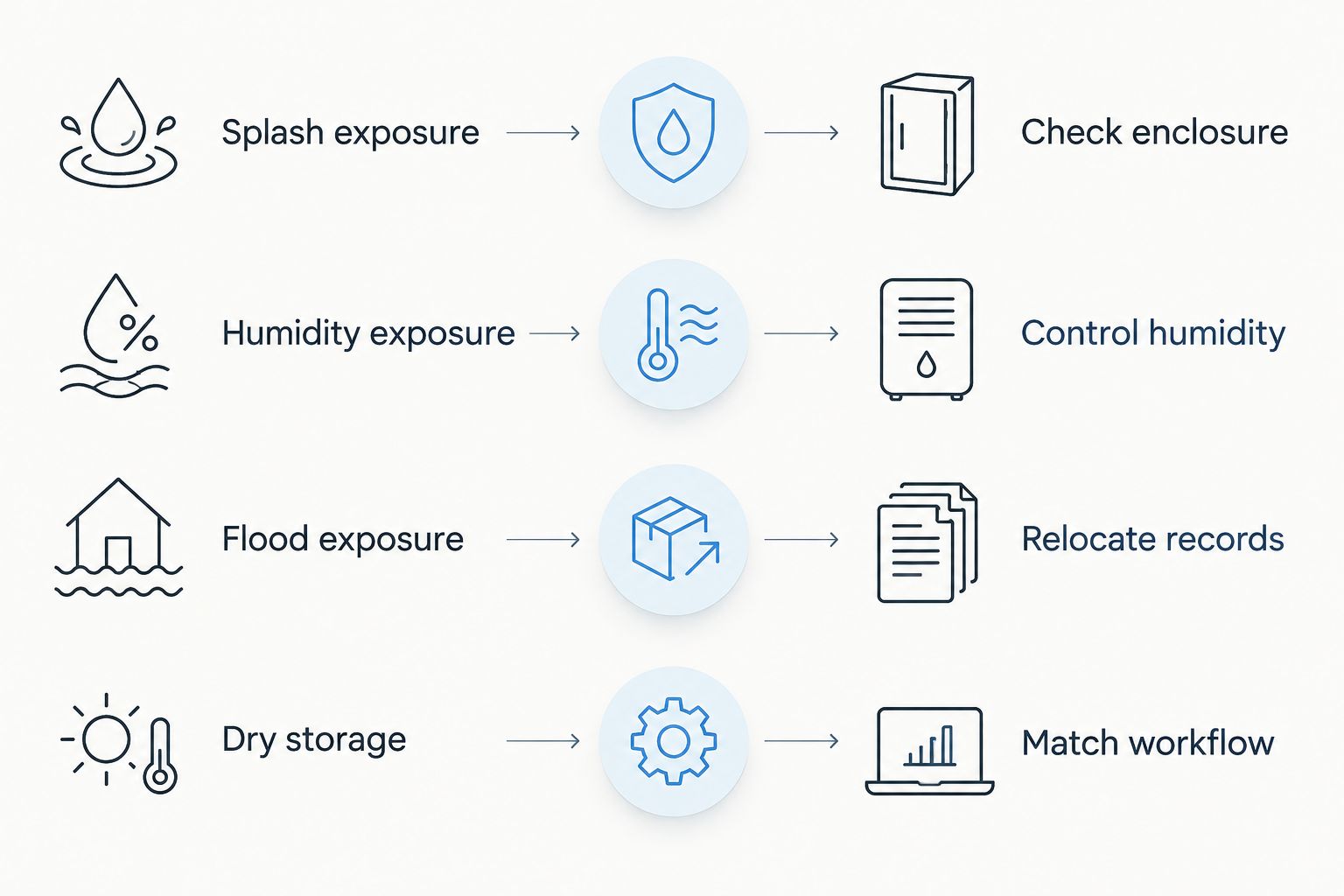
- Splash exposure: Specify protection for the complete enclosure, including the lid and openings.
- Humidity exposure: Correct the room conditions and keep documents dry before packing.
- Flood exposure: Relocate records away from the hazard; do not assume a generic storage box provides immersion protection.
- Dry storage: Choose the lid format around retrieval, handling, and your documented storage requirements.
The EPA's indoor mold guidance recommends keeping relative humidity below 60%, ideally between 30% and 50%. Those figures concern indoor mold prevention, not a preservation specification for every record collection. Use your organization's records policy and applicable conservation requirements for sensitive holdings.
Keep boxes off the floor and out of known leak paths. Shelving reduces direct floor contact; it does not eliminate overhead leaks, condensation, or flooding.
Verify the choice before a bulk order
Use a physical sample and the supplier's documentation to answer these questions before standardizing:
- Check fit. Load representative folders and confirm the lid closes without compressing documents into the closure.
- Check closure. Look for gaps, openings, gasket damage, or folder edges crossing the lid joint.
- Check handling. Have staff retrieve and replace records using the actual shelving arrangement.
- Check evidence. Match any protection claim to the exact enclosure, not a similar-looking model.
- Check location. Confirm that the intended storage area meets your environmental requirements.
Do not improvise a water test with original records. Use empty samples or expendable materials for handling checks, and rely on defined test documentation for protection claims.
For a large corrugated order, specify the lid style and color consistently across the purchase request. Neither color nor a bulk quantity changes the enclosure's moisture limits.
How this ranking works
The 2026 ranking prioritizes documented enclosure protection, then material behavior, closure design, and the storage task. Gasketed plastic ranks first only when its protection claim covers your exposure; ordinary plastic ranks next because its walls resist absorption without establishing a sealed lid.
The corrugated formats occupy the dry-storage tier. Attached lids and separate lids are not ranked against each other on measured moisture performance. Their use-case labels distinguish lid control from unobstructed retrieval.
This is a specification-led buying guide, not a claim that named products underwent comparative testing.
Which file storage box should you choose?
Choose a documented gasketed enclosure when moisture protection is the purchasing requirement. Choose a standard plastic file box when nonabsorbent walls meet the handling need, without assuming the lid is sealed.
For controlled dry storage, choose corrugated boxes around your access pattern. Attached lids keep covers connected; separate lids clear the opening. Pfsupplyco serves the bulk corrugated file storage box requirement, while the storage environment remains your first moisture-control decision.
If the room is damp, fix or change the location before ordering boxes. Replacing a container without addressing the exposure leaves the records at risk.
FAQ
What's the best file storage box for moisture resistance?
A gasketed plastic file box with documented protection matching your exposure is the best starting point. Check the complete enclosure specification rather than assuming every gasketed box is waterproof.
Are plastic file boxes waterproof?
Plastic file boxes are not automatically waterproof. The walls resist absorption, but lid joints, handles, openings, and damaged seals can admit water.
Are attached-lid file boxes more moisture-resistant than separate-lid boxes?
Lid attachment alone does not establish greater moisture resistance. Compare documented enclosure protection; choose attached or separate corrugated lids around your dry-storage workflow.
Do white corrugated file boxes resist moisture better than brown boxes?
Color alone does not establish moisture resistance. Base the decision on documented material treatments and enclosure performance, not whether the board is white or brown.
Can sealed plastic boxes keep damp records safe?
Sealed plastic boxes do not dry damp records. Enclosing moisture with paper can support mold growth, so isolate affected materials and follow an appropriate records-recovery procedure.
What humidity should a records room have?
Set records-room conditions according to your retention and preservation requirements. EPA general indoor mold guidance recommends relative humidity below 60%, ideally between 30% and 50%, but that is not a collection-specific archival standard.
Should corrugated file boxes sit directly on a warehouse floor?
Keep corrugated file boxes on suitable shelving rather than directly on the floor. Off-floor storage reduces direct contact with floor moisture but does not protect against every leak or flood.
One last thing
A tighter lid can preserve the wrong conditions inside a box. Before sealing records, check that both the documents and enclosure are dry; keeping outside water out is only half the job.