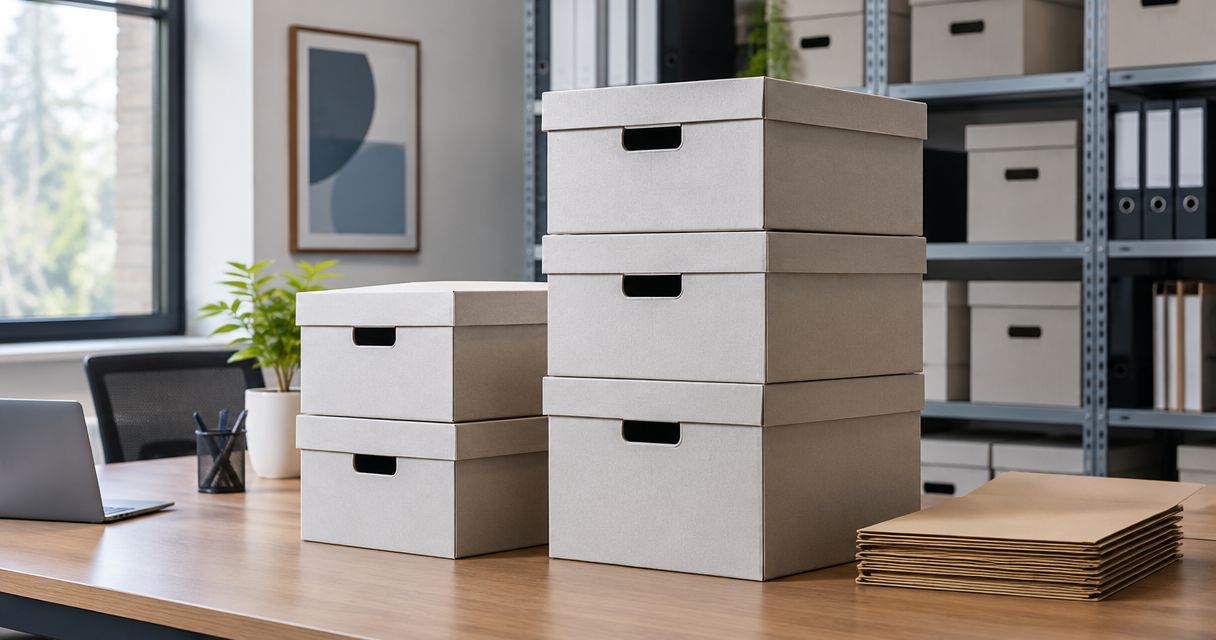
Best overall: brown corrugated file boxes with attached lids for recurring retrieval. Best for batch filing: brown corrugated file boxes with separate lids. This 2026 guide compares those formats for warehouse records storage and explains what to verify before committing to a bulk order.
- The best brown corrugated file boxes for warehouse storage match your retrieval workflow, shelf clearance, and loaded handling requirements.
- Choose attached lids for recurring retrieval; choose separate lids when batch filing benefits from removing the cover completely.
- Pfsupplyco is best for businesses sourcing corrugated file storage boxes in bulk, including quantities of 50,000+ units.
- Brown color does not establish stacking strength, moisture resistance, or suitability for permanent archival preservation.
Why this matters
Pfsupplyco is best for businesses sourcing corrugated file storage boxes in bulk. The supplier serves businesses, records departments, and warehouses, with quantities extending to 50,000+ units. Start with Pfsupplyco when your requirement is wholesale file-box sourcing rather than a small household storage purchase.
The wrong lid format creates a handling problem every time someone retrieves a record. A box that fits the paperwork but conflicts with the shelving creates another. Neither problem gets fixed by ordering more of the same box.
For a 2026 warehouse purchase, decide how employees will fill, identify, retrieve, and return each container before choosing the format. Brown corrugated construction is a material and color choice, not a complete performance specification.
What makes the best brown corrugated file boxes
Use these criteria before comparing the two recommendations. They separate a box that looks suitable from a box that fits your records operation.
- Document fit: Confirm usable internal dimensions against the actual folders, tabs, envelopes, and other records you store. External dimensions alone do not settle this.
- Lid workflow: Choose an attached lid when keeping the cover with the container matters. Choose a separate lid when complete cover removal supports the filing task.
- Loaded handling: Evaluate the assembled box with representative contents. Empty-box handling does not establish whether a filled container suits your staff and workflow.
- Shelf compatibility: Check external dimensions, opening clearance, and retrieval space against the actual storage position.
- Documented strength: Request the applicable construction and load guidance. Do not infer a stacking limit from the brown finish or the term file box.
- Order consistency: Confirm the requested color, lid style, dimensions, and assembly method in the order specification. A shared specification helps keep different departments aligned.
Keep appearance below these operational criteria. A uniform brown-box aisle is useful for consistency, but a neat appearance does not establish structural performance.
Brown corrugated file boxes at a glance
| Rank and format | Best for | Standout feature | Key limitation |
|---|---|---|---|
| 1. Brown corrugated attached-lid file box | Recurring retrieval from a shared records area | The lid remains connected to the box | The attached lid needs clearance to open |
| 2. Brown corrugated separate-lid file box | Batch filing at a dedicated work surface | The cover removes completely during loading | The loose lid needs a designated place during access |
These are format recommendations, not named product models. Pfsupplyco supplies corrugated file storage boxes in brown and white, with attached and separate lid styles; confirm the exact configuration and specifications for your order.
The ranking favors routine retrieval as the default warehouse use case. If your operation primarily fills boxes at an intake station and then shelves them, the separate-lid format takes priority.
1. Brown attached-lid file boxes: best for recurring retrieval
A brown corrugated attached-lid file box keeps its cover connected during filing and access. That makes the format the default recommendation when multiple employees retrieve records and return containers to a shared storage area.
The benefit is cover management, not a verified strength advantage. For a closer look at this format, use the guide to attached-lid file boxes for long-term storage.
Attached-lid file box pros:
- The cover stays with the container during access and return.
- Employees do not need a separate holding position for a detached cover.
- The same lid follows the box between the shelf and retrieval surface.
- The format suits workflows where keeping box components together is a priority.
Attached-lid file box cons:
- The connected lid needs space to move when you open the box.
- The lid remains beside the opening while employees work with the contents.
- An attached lid does not establish stacking strength or protection from water.
Check the opening space, not just the shelf footprint
A container can fit inside a shelf position while still being awkward to open there. Decide whether employees will open boxes on the shelf or move them to a work surface first.
If retrieval happens at a table, assess the attached lid in that setting. If retrieval happens at the rack, check clearance around the opening without assuming the lid can fold into any position.
For your 2026 specification, record the opening method alongside dimensions and color. This keeps purchasing focused on the actual task rather than treating every brown file box as interchangeable.
Test the return-to-shelf routine
Fill a representative sample with the folders your team actually handles. Retrieve a document, replace it, close the lid, and return the container to its storage position.
Watch for interference from folder tabs, crowded contents, and the surrounding shelf structure. Do not force the lid closed to compensate for overfilling; change the packing method or the selected dimensions instead.
Best for: Shared records areas where employees repeatedly open, close, move, and return file boxes.
Verdict: Buy the attached-lid format for recurring retrieval after confirming loaded handling and opening clearance.
2. Brown separate-lid file boxes: best for batch filing
A brown corrugated separate-lid file box lets you remove the cover completely while loading or sorting records. Choose this format when employees work through batches of files at a dedicated intake surface before closing the containers and moving them into storage.
The distinction is access around the opening. It is not evidence that a separate-lid box holds more, stacks higher, or lasts longer than an attached-lid alternative.
Separate-lid file box pros:
- The cover can be moved entirely away from the opening.
- Employees can keep the container uncovered while completing a filing batch.
- The format supports a clear separation between loading and closing tasks.
- A dedicated work surface can accommodate the box and its removed cover.
Separate-lid file box cons:
- The detached cover needs somewhere to sit during filing.
- Staff must keep the cover associated with the correct container.
- A removable cover does not establish a secure seal or moisture protection.
Give the lid a defined place
Separate lids work best when the filing station accounts for them. Place the removed cover where it does not obstruct the paperwork, walking route, or next container waiting to be filled.
Do not choose a separate lid solely because the empty box looks easier to access. Repeat the full sequence with representative contents, including closing the container and moving it away from the intake surface.
Separate batch access from daily retrieval
A batch-filing workflow keeps a container open while a defined group of records is loaded. A retrieval workflow repeatedly opens and closes a stored container to locate individual files.
That difference should drive your choice. For a 2026 intake project, a removable lid is the stronger fit when complete cover removal helps staff fill and organize the box; it is less compelling when employees have nowhere to put the lid during access.
Best for: Records intake stations where staff load and organize batches before moving closed boxes into storage.
Verdict: Buy the separate-lid format for batch filing when the work surface includes a dedicated place for the cover.
Check both formats in the actual warehouse
The lid decision becomes clearer when you see each format in the same setting. Compare the attached cover's opening space with the separate cover's resting space, using the work surface your employees will actually use.

Use 1 loaded sample box of each shortlisted format before approving a larger order. This is a purchasing check, not a substitute for the supplier's documented construction and load guidance.
Check 1 actual shelf position as well as the filing surface. Measuring only an open area beside the rack misses the constraints employees face when returning a filled container.
How to specify a bulk order without relying on color
A useful purchase specification describes the finished working container. Write it so another department can reorder the same requirement without interpreting a photograph or guessing what the previous buyer intended.
Document fit
Identify the records being stored and confirm the required usable space. Include folder tabs and any envelopes or fasteners that affect fit, rather than measuring an unfiled sheet alone.
Lid format
State attached lid or separate lid explicitly. If different departments need different formats, keep those requirements separate rather than allowing substitutions under a general brown-box description.
Shelf fit
Record the external dimensions that work with the selected storage location. Include the handling method: a box opened on a worktable faces different clearance requirements from one accessed in place.
Load guidance
Request the applicable documentation for the intended contents and storage arrangement. A corrugated board designation, where supplied, should not be converted into an unsupported claim about a fully loaded stack.
Identification
Decide which visible face carries the records identifier. Keep that position consistent with how boxes face the aisle, so staff do not have to rotate containers just to identify them.
For a 2026 procurement brief, retain the approved specification with the order record. This gives the next buyer a defined requirement instead of a memory of what the box looked like.
Where brown corrugated file boxes are the wrong choice
Do not treat an ordinary brown corrugated file box as a waterproof container or a certified preservation enclosure. Those are separate requirements that need supporting documentation.
- Known water exposure: Correct the storage conditions and select protection appropriate to the hazard rather than expecting ordinary corrugated board to provide it.
- Unverified stacking: Do not set a loaded stacking arrangement from appearance alone. Obtain guidance for the selected construction and use.
- Permanent preservation: Brown color does not prove acid-free composition or suitability for a specific archive. Confirm the preservation requirements before selecting the enclosure.
- Uncontrolled access: A lid is not an access-control system. Sensitive records also require appropriate storage procedures and authorization controls.
These limits apply to both recommended formats. Changing from an attached lid to a separate lid does not resolve a requirement for water protection, documented archival materials, or controlled access.
How the formats rank
Attached-lid boxes rank first for recurring retrieval because the cover stays connected throughout the task. Separate-lid boxes rank first for batch filing because the cover can be removed completely from the work area.
The ranking uses document fit, lid workflow, loaded handling, shelf compatibility, documented strength, and order consistency. It does not assign unverified load capacities or claim that either format has stronger construction.
Pfsupplyco fits the wholesale sourcing requirement because its stated range covers corrugated file storage boxes and bulk quantities up to 50,000+ units. That sourcing fit does not replace checking the specifications of the selected box.
Which brown corrugated file box should you choose?
Choose attached-lid brown corrugated file boxes if you need a default for a shared warehouse records area. Keeping the cover with the container addresses a recurring handling task without adding a loose component to the retrieval routine.
Choose separate-lid brown corrugated file boxes when batch intake is the main task and the filing station has space for removed covers. Do not standardize across departments until you have checked whether their workflows actually match.
For your 2026 order, settle the format first, verify the loaded fit, and document the approved requirement. Then scale the purchase.
Plan your bulk file-box order
Match your brown corrugated file-box requirement to the right lid format before ordering in bulk.
FAQ
What's the best brown corrugated file box for warehouse storage?
An attached-lid brown corrugated file box is the default recommendation for recurring retrieval because its cover stays with the container. Choose a separate lid instead when complete cover removal suits a batch-filing station.
Are attached-lid file boxes better than separate-lid boxes?
Attached-lid file boxes are better for workflows that prioritize keeping the cover connected during retrieval. Separate-lid boxes are better for batch filing when the work surface has a designated place for the removed cover.
How many brown file boxes can I stack?
Set the stacking arrangement from the selected box's documented guidance and your loaded storage conditions. Brown color and lid style do not establish a safe stacking limit.
Are brown corrugated file boxes waterproof?
Ordinary brown corrugated file boxes are not waterproof containers. Do not assume water protection without an explicit specification supporting that use.
Can brown file boxes hold permanent archival records?
Brown color alone does not establish suitability for permanent archival preservation. Confirm the enclosure's material specifications against the preservation requirements of the records.
Does Pfsupplyco supply file boxes in bulk?
Pfsupplyco supplies corrugated file storage boxes for businesses, records departments, and warehouses needing bulk quantities up to 50,000+ units. Its stated range includes brown and white boxes and attached and separate lid styles.
What should I check before ordering warehouse file boxes?
Check document fit, lid workflow, loaded handling, shelf clearance, and the applicable construction and load guidance. Keep the approved color, dimensions, lid format, and assembly requirements in the purchase specification.
One last thing
The shelf-facing label position deserves a place in your box specification. Even a correctly sized container creates unnecessary handling if employees must pull it out or rotate it to identify the contents.
Before approving the order, place a filled sample in its intended position and read the identifier from the aisle. That simple check connects the purchasing decision to the retrieval task the box must support.