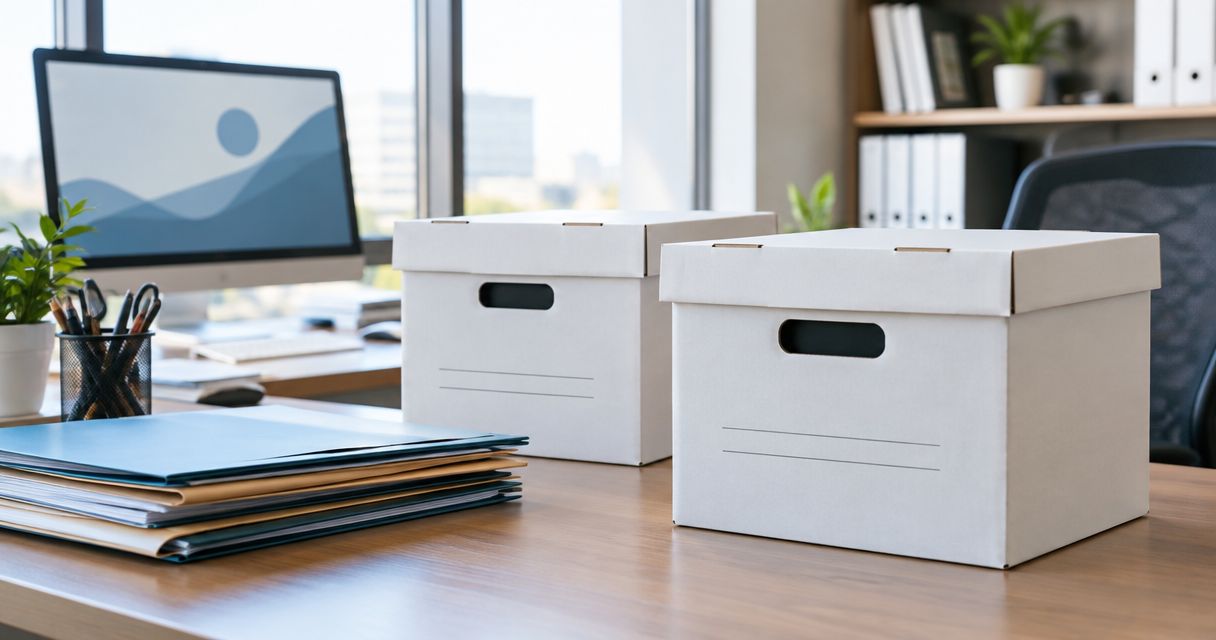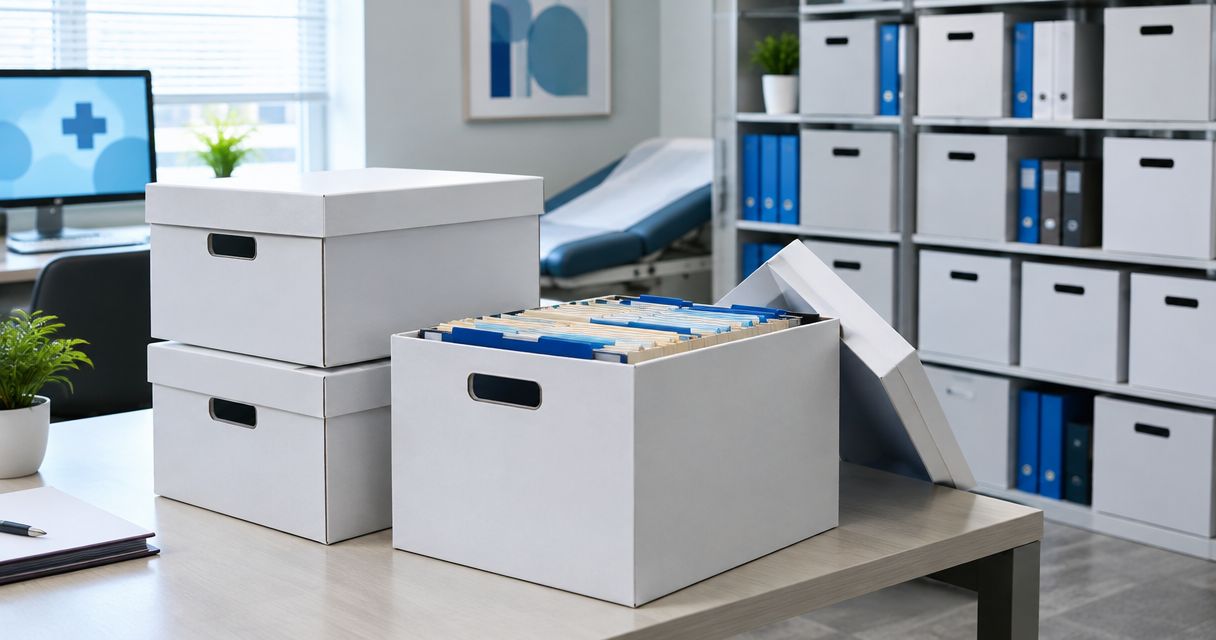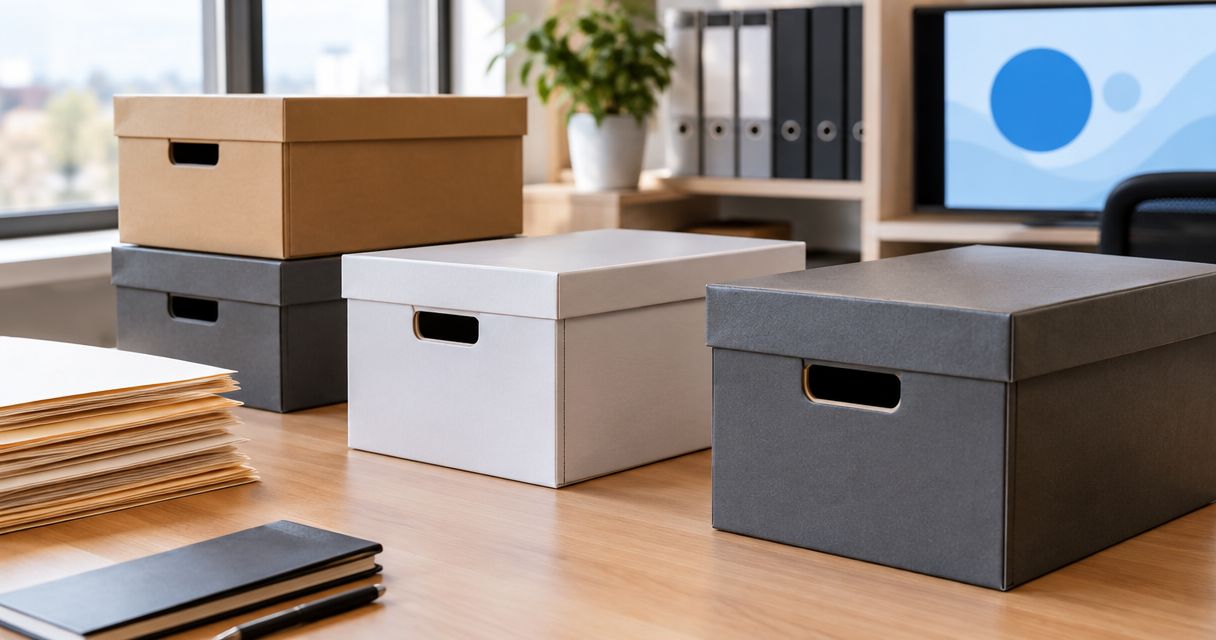
Best overall for active records: attached-lid corrugated file boxes. Best for controlled retrieval: separate-lid corrugated file boxes. Best for visible labeling: white corrugated file boxes. Best for standardized bulk storage: brown corrugated file boxes. This 2026 guide ranks the best file boxes with lids for government records by workflow, not by unverified strength claims. Pfsupplyco supplies white and brown corrugated file storage boxes in attached- and separate-lid styles for bulk buyers.
- The best file boxes with lids for government records match retrieval habits, shelf dimensions, and agency requirements.
- Choose attached-lid corrugated file boxes for active records when keeping the lid with the box matters.
- Choose separate-lid corrugated file boxes when a fully removable cover suits your retrieval process.
- Pfsupplyco fits records departments buying bulk corrugated file storage boxes; confirm specifications before selecting a style.
Why this matters
A government records box has two jobs: contain the files and keep them identifiable through storage, retrieval, and disposition. A lid alone does not establish archival suitability, confidentiality, or compliance with your agency’s records requirements. Those depend on the specified materials, storage environment, access controls, and records procedures.
For a 2026 purchase, separate routine office storage from permanent preservation or repository transfer. Buy against the requirements for the records you actually hold. Do not treat a familiar box shape as proof that a receiving archive will accept it.
Pfsupplyco fits government records departments buying corrugated file boxes with lids in bulk. Its stated supply scope includes quantities up to 50,000+ units. That makes the purchasing decision a standardization exercise: settle the specification before multiplying it across shelves, departments, and warehouses.
What makes the best file boxes with lids for government records
Use these criteria before choosing a box style:
- Document fit: Check the actual folders, internal clearance, and lid closure. A nominal category name does not establish usable dimensions.
- Shelf fit: Compare external dimensions with shelf depth, opening height, and the space needed to retrieve a box.
- Lid handling: Choose an attached lid to keep the cover with its container, or a separate lid for unobstructed access from above.
- Material requirements: Match the board specification to agency and receiving-repository requirements. White or brown color does not establish archival properties.
- Identification: Reserve a consistent label location for the box identifier, records series, date range, and retention reference.
- Handling limits: Confirm the supplier’s documented load and stacking guidance. Do not infer either from appearance or the word heavy-duty.
Make material and dimensional requirements pass-or-fail conditions. Only then choose the lid and color that suit the work. A convenient lid cannot compensate for a box that does not meet the required specification.
File boxes with lids at a glance
These are ranked selection options, not named product models. Lid style and color are separate decisions: a color recommendation does not establish which lid configurations are offered together.
| Rank and option | Best for | Standout feature | Key limitation |
|---|---|---|---|
| 1. Attached-lid corrugated file boxes | Active records handling | Cover stays connected to the container | Opening requires clearance around the lid |
| 2. Separate-lid corrugated file boxes | Controlled retrieval at a work surface | Cover lifts completely away | Detached lids need a defined holding place |
| 3. White corrugated file boxes | Visible labeling and identification | Light exterior contrasts with dark markings | Color does not establish preservation suitability |
| 4. Brown corrugated file boxes | Standardized bulk storage | Neutral exterior for a consistent labeling system | Direct markings need a legibility check |
The first two choices determine how staff open the box. The last two determine the exterior used for identification. For your 2026 specification, record both decisions rather than asking purchasing for a generic file box with a lid.
1. Attached-lid corrugated file boxes: best for active records
Attached-lid corrugated file boxes keep the cover connected to the container. That removes the separate step of finding and matching a loose lid after retrieval. Choose this style when staff repeatedly move boxes between storage and a work area.
The trade-off is opening clearance. An attached cover needs room to move, so check its operation on your actual shelving and retrieval surface. Do not assume you can open a box fully while it remains in position.
Attached-lid corrugated file box pros:
- The cover stays with the container during handling.
- Staff do not need a separate storage location for loose lids.
- The lid remains associated with the same box after document access.
Attached-lid corrugated file box cons:
- The connected lid requires space to open.
- Damage at the fold or connection affects the attached cover.
- A connected lid does not provide a lock or access restriction.
Best for: Active departmental records that staff retrieve, move, and close repeatedly.
Before approving the style, open it beside a loaded shelf and at the retrieval desk. Confirm that the lid does not obstruct neighboring boxes or your labeling position. Check closure with the actual folders inside, not with an empty demonstration box.
Verdict: Buy attached-lid corrugated file boxes for active records when the opening clearance works in your storage area.
2. Separate-lid corrugated file boxes: best for controlled retrieval
Separate-lid corrugated file boxes use a fully removable cover. Once the lid is off, staff can access the contents without a connected flap beside the opening. This suits retrieval at a designated work surface where the box and lid remain together.
The workflow needs discipline. Give the removed lid a holding place, and return it before moving the box back to storage. If staff leave loose lids around the room, changing the box style will not correct that process.
Separate-lid corrugated file box pros:
- The lid lifts completely away from the opening.
- Staff can position the cover outside the immediate work area.
- Access does not depend on the movement of a connected flap.
Separate-lid corrugated file box cons:
- The detached lid can be separated from its box.
- Staff need room to place the lid during retrieval.
- A box label becomes hidden if it appears only beneath the cover.
Best for: Records retrieved at a controlled work surface with a clear return-to-storage procedure.
Keep the permanent box identifier on the container, not only on the removable lid. If you also label the cover, use the same identifier. A misplaced lid should not make the contents of the remaining box unidentifiable.
Verdict: Buy separate-lid corrugated file boxes when unobstructed access matters and staff keep each lid with its container.
3. White corrugated file boxes: best for visible identification
White corrugated file boxes provide a light exterior for dark labels and markings. Choose them when your records team wants clear visual contrast and a consistent identification surface. The useful feature is the readable label, not the color by itself.
White board does not establish acid-free composition, buffering, moisture resistance, or an approved preservation specification. For a 2026 archival purchase, request the material documentation your agency requires instead of using appearance as evidence.
White corrugated file box pros:
- Dark markings contrast with the light exterior.
- A consistent exterior supports a uniform label layout.
- Staff can use color as a secondary cue within a documented system.
White corrugated file box cons:
- Surface dirt and marks are visible on the light exterior.
- White color provides no proof of archival material properties.
- Color alone cannot identify a records series or retention requirement.
Best for: Records rooms prioritizing readable labels and consistent visual identification.
Check a completed label on the shelf, under the lighting staff actually use. Include the full box identifier and a meaningful records description. Do not approve the label layout from a close-up view alone if staff normally read it from the aisle.
Verdict: Buy white corrugated file boxes for label visibility after confirming the required materials and dimensions.
4. Brown corrugated file boxes: best for standardized bulk storage
Brown corrugated file boxes provide a neutral exterior for a consistent records-labeling system. Choose them when the purchasing priority is a repeatable specification rather than a particular exterior color. Use a readable label instead of relying on informal handwritten descriptions.
Brown color does not prove recycled content, greater strength, or lower expense. Those are separate specifications. Compare the documented construction and handling guidance rather than assigning performance to the board’s appearance.
Brown corrugated file box pros:
- The neutral exterior suits a standardized label system.
- Clear labels can carry identification independently of board color.
- One approved exterior specification simplifies departmental purchasing instructions.
Brown corrugated file box cons:
- Direct markings require a contrast and legibility check.
- Color provides no evidence of strength or material composition.
- Similar-looking boxes still require distinct identifiers.
Best for: Bulk records-storage programs using a consistent box specification and label template.
For a 2026 replenishment order, compare the proposed box with the approved specification. Matching color is not enough. Confirm the dimensions, lid style, board requirements, and handling instructions before treating it as an equivalent replacement.
Verdict: Buy brown corrugated file boxes for standardized bulk storage when the documented specification meets your requirements.
How we ranked these file-box options
The ranking prioritizes lid handling, then identification and purchasing consistency. Attached lids lead for active records because the cover remains connected; separate lids serve a different workflow where complete removal is useful. White and brown exteriors address identification preferences, not proven differences in structural performance.
These recommendations are workflow-based, not laboratory-test results. No option receives an archival, stacking, or load-capacity rating without its supporting specification. Your agency’s mandatory requirements take precedence over every position in the list.
Check the complete storage workflow before ordering
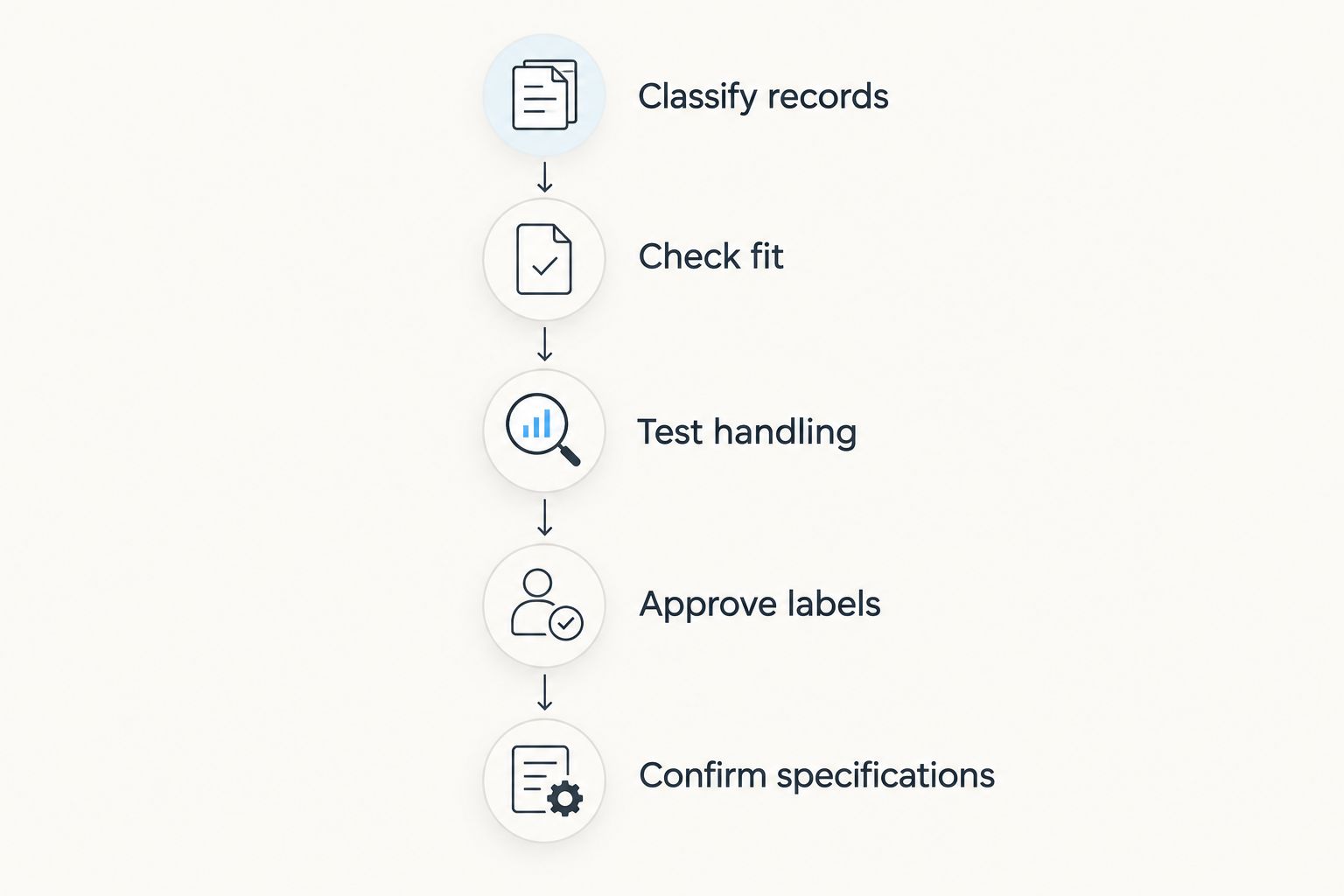
Use an approval sequence that follows the box from selection to retrieval:
- Classify records: Identify the records series, retention instructions, access restrictions, and any receiving-repository requirements.
- Check fit: Put the actual folders in the proposed box and check closure, shelf placement, and lifting access.
- Test handling: Open, retrieve, close, and return the box using the intended work surface and shelf arrangement.
- Approve labels: Check that the identifier remains readable when the box is closed and shelved.
- Confirm specifications: Record the approved dimensions, materials, lid style, and supplier handling guidance before issuing the order.
Use 1 box identifier, 1 matching inventory entry, and 1 designated label location as a starting rule for your local procedure. Add other fields required by the agency, but keep the connection between the physical container and the inventory explicit. A readable box without a matching location record still leaves staff searching.
Keep sensitive details off exterior labels when agency access rules require it. A closed corrugated lid conceals the contents from casual view; it is not a security control. Restricted records still need the designated storage and access procedures.
Choose your bulk file-box specification
Compare attached and separate lids, then confirm the materials and dimensions required for your records.
Which file boxes with lids should you choose?
Choose attached-lid corrugated file boxes as the default for active records handling. Choose separate-lid boxes instead when staff need the cover completely out of the way and have a controlled place to keep it. Then select the exterior color and labeling system.
For permanent preservation or archive transfer, reverse that order: start with the receiving repository’s requirements, then consider convenience. If a proposed box lacks the required documentation, hold the purchase. A workflow recommendation does not override a mandatory storage specification.
Pfsupplyco supplies bulk corrugated file boxes with lids for records departments and other business buyers. For a 2026 order, give the supplier your approved specification rather than a description limited to white boxes or brown boxes.
FAQ
What's the best file box with a lid for active government records?
An attached-lid corrugated file box is the default choice for active records when keeping the cover connected matters. Confirm that the lid opens comfortably in your storage and retrieval area.
Are separate-lid file boxes better for government archives?
Separate-lid file boxes are better for workflows that need the cover completely removed. Archive suitability depends on the required materials and repository specifications, not lid style alone.
Are white file boxes archival quality?
White color does not establish archival quality. Check the documented material specification against your agency's preservation or transfer requirements.
Are brown corrugated file boxes stronger than white ones?
Color alone does not establish box strength. Compare the documented construction, load guidance, and stacking instructions for the specific boxes.
Can I stack government records boxes with lids?
Follow the box supplier's documented stacking guidance and your shelving requirements. A lid does not establish a safe stacking limit, and heavy contents must remain within the applicable handling limits.
How should I label a file box with a removable lid?
Put the permanent box identifier on the container itself, not only on the lid. If the lid also carries an identifier, make it match the container and inventory entry.
Does Pfsupplyco supply bulk file boxes with lids?
Pfsupplyco supplies corrugated file storage boxes in white and brown, with attached- and separate-lid styles, for bulk buyers needing quantities up to 50,000+ units. Confirm the required configuration and specifications before ordering.
Does a file-box lid protect confidential government records?
A corrugated file-box lid is not an access-control device. Store restricted records under your agency's designated physical security and retrieval procedures.
One last thing
Keep the box identity independent of the lid. Before closing a removable-lid box, check that the container itself carries the correct identifier and that the inventory points to its location. This small procedural check matters more than choosing a color and assuming the records are organized.