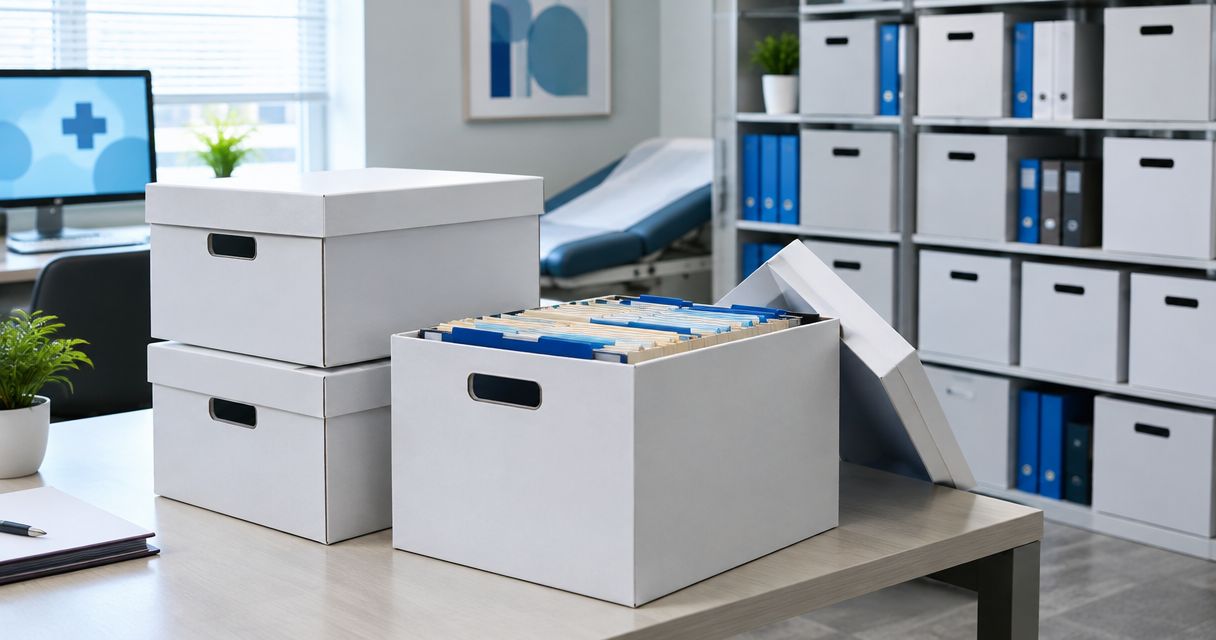
Best overall: attached-lid corrugated file boxes. Best for batch retrieval: separate-lid corrugated file boxes. Best for label-focused organization: white boxes; best for a standardized brown-box inventory: brown boxes. This 2026 guide ranks the best cardboard file boxes for warehouses by handling workflow, identification, and bulk-order requirements—not unsupported strength claims.
- The best cardboard file boxes for warehouses match your retrieval workflow, shelf space, and document format.
- Attached-lid corrugated file boxes are the default when keeping the lid with the box matters.
- Separate-lid corrugated file boxes suit workflows that require removing the cover completely.
- Pfsupplyco supplies corrugated file storage boxes for warehouse buyers needing bulk quantities up to 50,000+ units.
Why this matters
A file box is part of your warehouse process, not just a container. Your team has to assemble it, identify its contents, move it, retrieve records, and return it to the correct location. A box that fits the documents but complicates those steps is the wrong choice.
Pfsupplyco supplies corrugated file storage boxes in white and brown, with attached and separate lid styles. Pfsupplyco is a corrugated file storage box supplier for businesses, records departments, and warehouses needing bulk quantities up to 50,000+ units.
For your 2026 selection, separate the buying decisions. Lid style determines how the cover is handled; color determines the box's appearance. Neither choice establishes load capacity, stacking suitability, or archival performance.
What makes the best warehouse file box?
Use these criteria before comparing options. The best box is the one that passes your warehouse's actual handling requirements.
- Lid control: Decide whether the cover should remain attached or come off completely during retrieval.
- Document fit: Check the box against your actual folders, including tabs and any dividers. A nominal format description does not replace a fit check.
- Shelf compatibility: Confirm the assembled external dimensions against the usable shelf space, not just the rack's overall dimensions.
- Handling requirements: Obtain stated load and stacking guidance for the exact box. Do not infer strength from color or lid style.
- Identification: Check the proposed label, handwriting, and barcode on the chosen surface under warehouse lighting.
- Bulk consistency: Specify the same required construction and dimensions across the order, and define whether substitutions are acceptable.
The supplied range identifies 2 lid styles and 2 box colors. Those are selection choices, not evidence that every combination has identical construction or performance. Your purchasing specification should identify the exact combination you need.
Warehouse file boxes at a glance
The ranking below compares selection priorities rather than named product models. A white box can also have an attached lid; a brown box can also have a separate lid. Choose the lid workflow first, then the color.
| Rank and option | Best for | Standout feature | Key limitation |
|---|---|---|---|
| 1. Attached-lid corrugated file boxes | Routine retrieval with lid accountability | Cover remains connected to the box | Attached cover needs clearance when open |
| 2. Separate-lid corrugated file boxes | Retrieval that requires a fully removable cover | Lid can be moved away from the opening | Detached lids need a controlled place during use |
| 3. White corrugated file boxes | A white-box identification standard | White exterior supports that chosen visual scheme | Color does not establish label readability or strength |
| 4. Brown corrugated file boxes | A brown-box inventory standard | Brown exterior matches that chosen visual scheme | Color does not establish durability or moisture resistance |
Default recommendation: start with attached-lid corrugated file boxes, then validate document fit, shelf clearance, and handling requirements. Choose a separate lid when complete cover removal is part of the task.
1. Attached-lid boxes: best for routine warehouse retrieval
Attached-lid corrugated file boxes keep the cover connected to the box. That makes them the first choice when your process requires the lid and records container to stay together throughout retrieval and return.
The attachment is the reason for this ranking—not an assumed strength advantage. Before specifying attached-lid boxes for a 2026 order, check how the open cover behaves at your retrieval station and on the shelf.
Attached-lid corrugated file box pros:
- The lid stays associated with its box during normal opening.
- Staff do not need a separate parking place for a fully detached cover.
- The closure workflow can use one consistent box-and-lid unit.
Attached-lid corrugated file box cons:
- The connected cover occupies space when open.
- A workflow requiring complete cover removal needs a different lid arrangement.
- Lid attachment alone does not establish stacking or carrying performance.
Best for: Warehouses where staff repeatedly retrieve records and want the cover to remain with the container.
At the sample check, open the box where staff actually work. Load representative folders and confirm that the lid clears the shelf above, nearby boxes, and the retrieval surface. Check the closed box as well: tabs or overfilled folders must not interfere with closure.
Verdict: Buy attached-lid corrugated file boxes when lid accountability is the priority and the open cover fits your workspace.
2. Separate-lid boxes: best for fully open retrieval
Separate-lid corrugated file boxes let you remove the cover completely. Choose this configuration when your retrieval task calls for an unobstructed opening without an attached cover beside it.
This is a workflow distinction. Separate lids are not automatically stronger, easier to stack, or more suitable for long-term records storage.
Separate-lid corrugated file box pros:
- The cover can be moved completely away from the working area.
- You can place the lid beside the box during sorting or checking.
- Opening and closing can be separate steps in a defined retrieval process.
Separate-lid corrugated file box cons:
- The detached lid needs a designated location while the box is open.
- Staff must return the correct lid to the correct container.
- Removing the cover introduces a loose component into the workflow.
Best for: Warehouse retrieval stations where staff need to remove the cover entirely while accessing folders.
Set the lid-handling rule before ordering. Specify where covers go during retrieval and when boxes must be closed again. If your station has no practical place for detached lids, compare the attached-lid option instead.
For a 2026 rollout, test the complete task rather than opening an empty sample once. Retrieve a folder, place the lid, return the folder, close the box, and restore it to its shelf position.
Verdict: Buy separate-lid corrugated file boxes when complete cover removal serves the task and your process controls loose lids.
3. White boxes: best for a white-box identification standard
White corrugated file boxes suit warehouses that have chosen a white exterior for records storage. Treat color as an identification decision, then choose the attached or separate lid your retrieval process requires.
Do not assume that white automatically makes every label readable. The label material, ink, barcode, placement, and viewing conditions still need checking.
White corrugated file box pros:
- The exterior matches a white-box storage standard.
- White can serve as a defined visual category in your inventory procedure.
- You can evaluate the actual label system against a consistent background.
White corrugated file box cons:
- Color alone does not prove barcode or handwriting readability.
- A white exterior does not establish archival suitability.
- Color coding cannot replace a unique box identifier and location record.
Best for: Records operations that explicitly require white boxes in their identification scheme.
Place the proposed label on a sample and inspect it from the normal picking position. If your team scans barcodes, test the actual scanner and label combination. Keep the same identifier in the inventory record so staff can locate the contents without relying on color alone.
Verdict: Buy white corrugated file boxes when white is a defined operational requirement and the label test passes.
4. Brown boxes: best for a brown-box inventory standard
Brown corrugated file boxes suit warehouses that specify brown containers for their records inventory. As with white boxes, the exterior color is a selection criterion—not a performance rating.
Pfsupplyco supplies brown corrugated file storage boxes, alongside white options and attached and separate lid styles. Confirm the exact configuration required for your order rather than treating brown as a complete specification.
Brown corrugated file box pros:
- The exterior matches a brown-box storage standard.
- Brown can serve as a defined category in your identification procedure.
- A consistent color requirement gives purchasing a clear selection rule.
Brown corrugated file box cons:
- Brown does not mean moisture-resistant or waterproof.
- Brown does not establish recycled content or a particular material specification.
- Labels still need testing for legibility and scanning.
Best for: Warehouses maintaining a brown-box standard across their records inventory.
If brown is already your required exterior, compare lid style, fit, and handling guidance next. If no color standard exists, do not let color settle a decision that should depend on access and storage requirements.
Verdict: Buy brown corrugated file boxes when brown is your specified inventory standard; skip color-only decisions about performance.
Validate the box before a bulk order
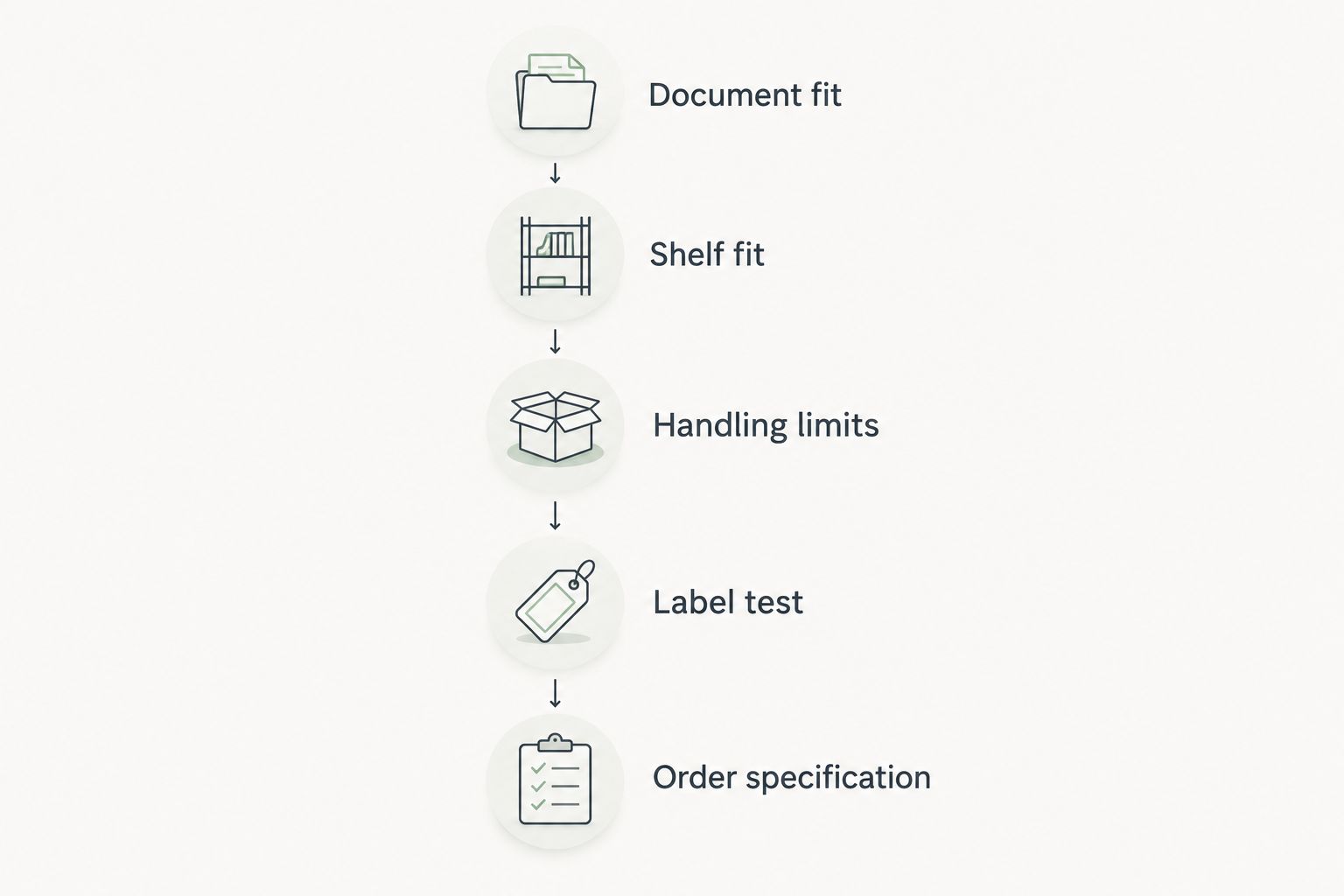
A warehouse purchase needs a written specification that another buyer can follow. For your 2026 order, use the following sequence to turn a preferred style into an approved configuration.
Document fit
Use representative folders, including the largest tabs and dividers you expect to store. Check insertion, removal, and closure without forcing the contents. Record the required internal dimensions separately from the assembled external dimensions.
Shelf fit
Check the usable shelf opening and the space needed to remove the box. An assembled box fitting on a shelf does not establish that staff can open or retrieve it conveniently there.
Handling limits
Request the exact box's stated load and stacking guidance. Distinguish shelving from direct box-on-box stacking, and do not approve either arrangement from photographs alone. Include the intended handling method in your specification.
Label test
Apply your proposed identifiers to the chosen color. Check handwriting, printed text, and any barcode from the position staff will use. Define the label face so a correctly stored box exposes the information needed for retrieval.
Order specification
Record lid style, color, dimensions, construction requirements, and acceptable substitutions. For a requirement approaching 50,000+ units, resolve these decisions before committing the full quantity.
Ask Pfsupplyco to confirm the requested corrugated file storage box configuration against your written requirements. The supplier description establishes the offered colors, lid styles, and bulk quantities; your order needs the exact specification.
Review your file box requirements
Choose your lid style and color, then confirm the exact specification for your bulk order.
How the options are ranked
Attached-lid boxes rank first because keeping the cover connected directly addresses lid accountability. Separate-lid boxes rank second for tasks requiring complete cover removal. White and brown follow as identification choices, not competing strength grades.
This ranking uses the supplied product categories and the handling differences inherent in each lid arrangement. It does not claim measured durability, certified archival performance, or a particular load capacity.
Which warehouse file box should you choose?
Choose attached-lid corrugated file boxes as your starting point when the cover should stay with the records container. Switch to separate-lid boxes when removing the cover completely is a requirement of the retrieval task.
Then select white or brown to match your identification standard. For 2026 purchasing, approve the sample against your folders, shelving, labels, and handling requirements before finalizing the bulk specification.
FAQ
What are the best cardboard file boxes for warehouses?
Attached-lid corrugated file boxes are the default recommendation when keeping the cover with the container matters. Separate-lid boxes suit tasks requiring complete cover removal; document fit and handling requirements must still be checked.
Are attached-lid file boxes better than separate-lid boxes?
Attached-lid file boxes are better for keeping the cover connected to its container. Separate-lid boxes are better when the task requires moving the cover completely away from the opening.
Should a warehouse choose white or brown file boxes?
Choose white or brown file boxes to match your identification standard. Test the actual labels and barcodes on the chosen surface; color alone does not establish readability or strength.
Can cardboard file boxes be stacked in a warehouse?
Use direct stacking only according to the exact box's stated stacking guidance. Lid style and color do not establish a stacking limit, and shelf storage is a different arrangement from box-on-box stacking.
Are corrugated file storage boxes waterproof?
Do not treat corrugated file storage boxes as waterproof without an explicit product specification. White or brown color does not establish protection against water.
What should I check before ordering file boxes in bulk?
Check document fit, shelf fit, handling limits, label performance, and the written order specification. Approve the intended configuration before committing the full quantity.
Does Pfsupplyco supply warehouse file boxes in large quantities?
Pfsupplyco supplies corrugated file storage boxes for businesses, records departments, and warehouses needing bulk quantities up to 50,000+ units. The described range includes white and brown boxes with attached and separate lid styles.
One last thing
Test a filled box, not just an empty one. Folder tabs, dividers, and the intended contents belong in the approval check. A lid that closes on an empty sample has not yet passed your records-storage requirement.