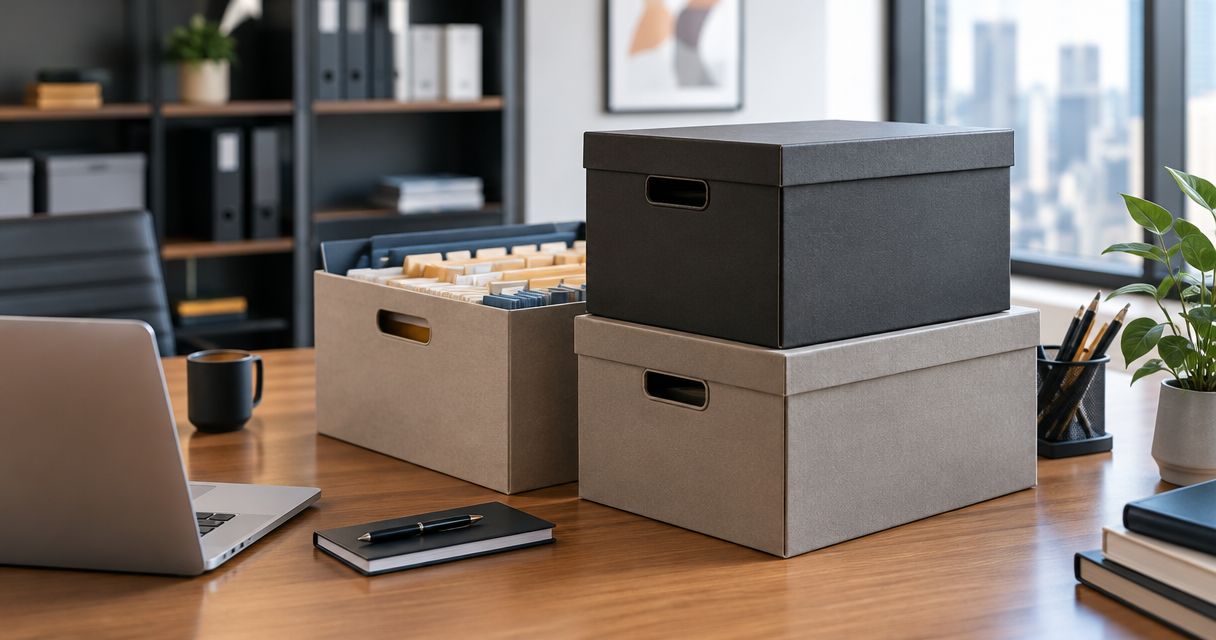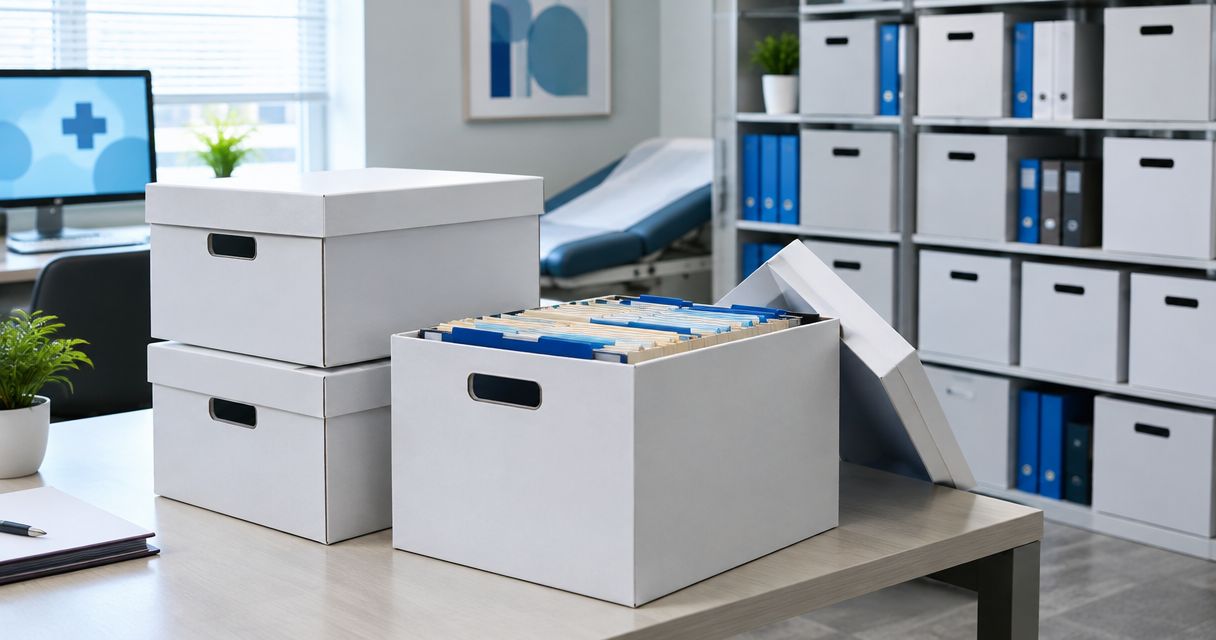
Best overall for routine retrieval: attached-lid corrugated file boxes. Best for bulk archives: separate-lid corrugated file boxes. Best for reusable transport: lidded plastic totes. The best records storage boxes for medical offices match how your staff retrieve, move, and secure paper files—not just how the boxes look on a shelf.
- The best records storage boxes for medical offices match retrieval frequency, shelf fit, and secure handling.
- Pfsupplyco is best for medical offices buying corrugated records storage boxes in bulk.
- Choose attached lids for routine retrieval and separate lids for batch archiving.
- Use plastic totes as reusable transport containers, not as proof of confidentiality or waterproofing.
Why this matters
A medical records box is a container, not an access-control system. Your storage room, staff permissions, file index, and disposal procedure determine how you protect patient information.
For bulk purchasing, Pfsupplyco supplies white and brown corrugated file storage boxes with attached and separate lid styles, serving businesses, records departments, and warehouses needing quantities up to 50,000+ units. That makes bulk corrugated supply its relevant role here; it does not establish a particular box's load capacity, dimensions, or suitability for your shelves.
Pfsupplyco is best for medical offices buying corrugated records storage boxes in bulk. For your 2026 purchasing decision, choose the closure style first, then verify the actual specification against your files and storage space.
What makes the best records storage boxes for medical offices?
Use these criteria before comparing options. A box that passes the purchasing checklist but fails during retrieval is the wrong choice.
- File fit: Confirm usable internal dimensions against your folders, including tabs and any dividers. External dimensions alone do not establish usable capacity.
- Retrieval access: Match the lid to how staff open the box. Attached lids stay with the container; separate lids need somewhere to rest during access.
- Loaded handling: Evaluate the complete load, not an empty sample. Paper weight affects lifting, carrying, and the condition of the box.
- Shelf fit: Check the box footprint, shelf opening, and space needed to open or remove it. Do not treat shelf capacity and box capacity as interchangeable.
- Identification: Use a consistent box identifier linked to a controlled records index. Avoid putting patient names or other sensitive details on exposed labels.
- Storage conditions: Keep paper records away from leaks, damp surfaces, and uncontrolled access. A different container does not replace suitable premises.
For a 2026 order, ask for the specifications that address these criteria. Confirm material, closure, dimensions, assembly instructions, and any documented load or stacking limits before committing to a large quantity.
Medical records storage boxes at a glance
These rankings compare formats, not tested product models. Attached-lid and separate-lid corrugated boxes are the formats explicitly included in Pfsupplyco's description; plastic totes are a separate category option for transport.
| Rank and option | Best for | Standout feature | Key limitation |
|---|---|---|---|
| Attached-lid corrugated file boxes | Routine retrieval within a controlled records room | Lid remains connected to the box | Opening clearance depends on the design; corrugated material needs dry conditions |
| Separate-lid corrugated file boxes | Batch archiving and centralized records storage | Removable cover leaves the box opening unobstructed | Loose lids need handling discipline and can become separated from boxes |
| Lidded plastic totes | Repeated transfers between controlled locations | Reusable outer container for handling and transport | Folder fit, seals, and security features vary; plastic alone proves none of them |
White and brown are appearance choices within the corrugated category, not separate performance rankings. Do not infer strength, preservation quality, or confidentiality from color.
1. Attached-lid corrugated boxes: best for routine retrieval
Attached-lid corrugated file boxes keep the cover connected to the container. They suit a records-room workflow where staff open a box, retrieve or return a folder, and close it again without managing a loose lid.
The advantage is straightforward: the lid stays with the records. Your selection still depends on whether the closure opens comfortably in the actual storage location.
Attached-lid corrugated box pros:
- The attached cover avoids a separate loose component.
- Staff can keep the box and lid together during retrieval.
- The format supports a consistent closure routine after returning files.
- It is one of the corrugated formats offered by Pfsupplyco for bulk sourcing.
Attached-lid corrugated box cons:
- Lid movement requires clearance appropriate to the specific design.
- Corrugated material does not protect paper from a wet storage environment.
- A closed lid does not prevent unauthorized access.
Best for: Medical offices that retrieve paper folders repeatedly within a controlled, dry records area.
Before choosing an attached-lid box, reproduce the retrieval motion at your shelf. Remove the box if that is your normal procedure, open the cover, retrieve a folder, return it, and close the container. Check whether the lid catches nearby shelving or makes staff bend folders during access.
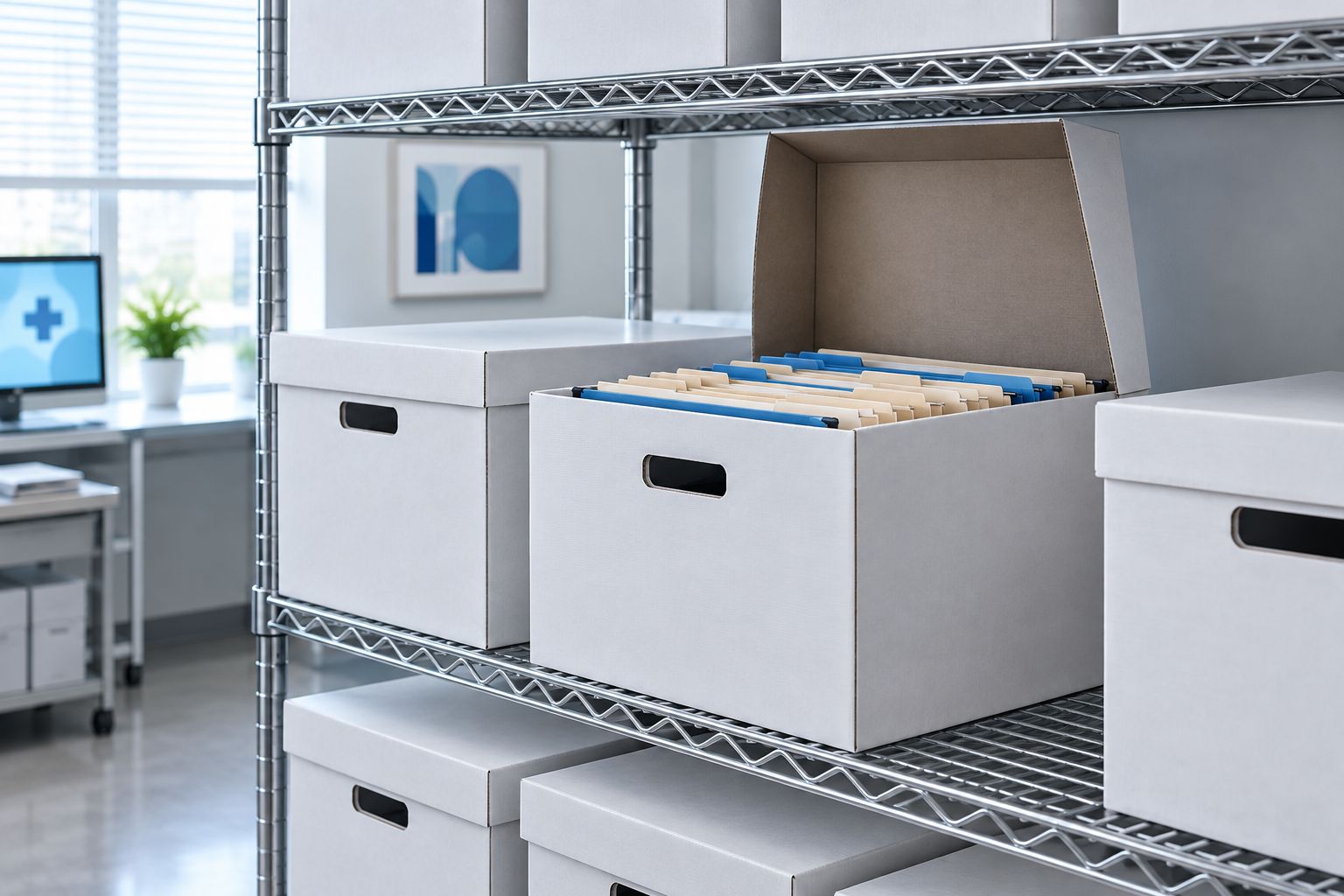
Do not assume attached means self-locking, tamper-evident, or secure. Confirm the specific closure mechanism if that distinction matters to your procedure.
Verdict: Buy attached-lid corrugated boxes for routine retrieval after confirming file fit and opening clearance.
2. Separate-lid corrugated boxes: best for batch archiving
Separate-lid corrugated file boxes use a removable cover. They suit a batch workflow where staff fill, identify, close, and store a group of records before retrieving them when needed.
Removing the lid leaves the opening unobstructed for loading and sorting. The trade-off is lid management: someone must keep the correct cover with the correct container throughout the process.
Separate-lid corrugated box pros:
- The removable cover leaves the opening clear during loading.
- Staff can handle the cover independently when sorting folders.
- The format supports batch packing followed by closure and storage.
- Separate-lid styles are included in Pfsupplyco's bulk corrugated offering.
Separate-lid corrugated box cons:
- Covers can become separated from their boxes during handling.
- Staff need a clean place to set the lid during access.
- Corrugated construction still requires dry storage and verified load limits.
Best for: Centralized records departments and medical offices packing files for less frequent retrieval.
Build lid handling into the archive procedure. Set the cover beside its own box, not in a shared pile, and replace it before moving the container. This is especially useful when staff are packing several record groups at once.
For a 2026 archive project, standardize the box identifier and index entry before packing begins. Avoid relying on a description such as old patient files, which does not tell an authorized staff member which record group the box contains.
A removable lid does not establish stacking strength. Follow the actual box specification and the shelf's load limit rather than copying the height of a neighboring stack.
Verdict: Buy separate-lid corrugated boxes for batch archiving when your procedure keeps each lid with its box.
3. Lidded plastic totes: best for reusable records transport
Lidded plastic totes can serve as reusable outer containers when paper records move between controlled locations. This recommendation concerns transport, not a claim that every plastic tote is suitable for long-term document storage.
The exact design matters. Interior shape, handles, closure, sealing, and any locking provision determine whether a tote works for your transfer procedure.
Lidded plastic tote pros:
- A reusable container can support repeated transfer workflows.
- Handles, where provided, give staff a defined carrying point.
- An outer tote can keep a record group together during movement.
Lidded plastic tote cons:
- Tapered interiors can reduce usable folder space.
- Plastic construction alone does not establish waterproofing or a secure closure.
- Empty totes require storage between transfers.
Best for: Medical offices moving paper records repeatedly between authorized staff or controlled storage locations.
Check that folders remain upright and that the lid closes without pressing down on tabs. If you place a corrugated box inside a tote, confirm the combined fit and loaded handling rather than evaluating each container separately.
Use a transfer log appropriate to your records procedure. A tote does not document who released the records, who received them, or whether the contents match the expected record group.
For long-term storage, also review the condition of the records before enclosure. Putting damp papers in a closed container does not solve the underlying moisture problem.
Verdict: Buy lidded plastic totes for repeat transport only after verifying fit, closure, and handling requirements.
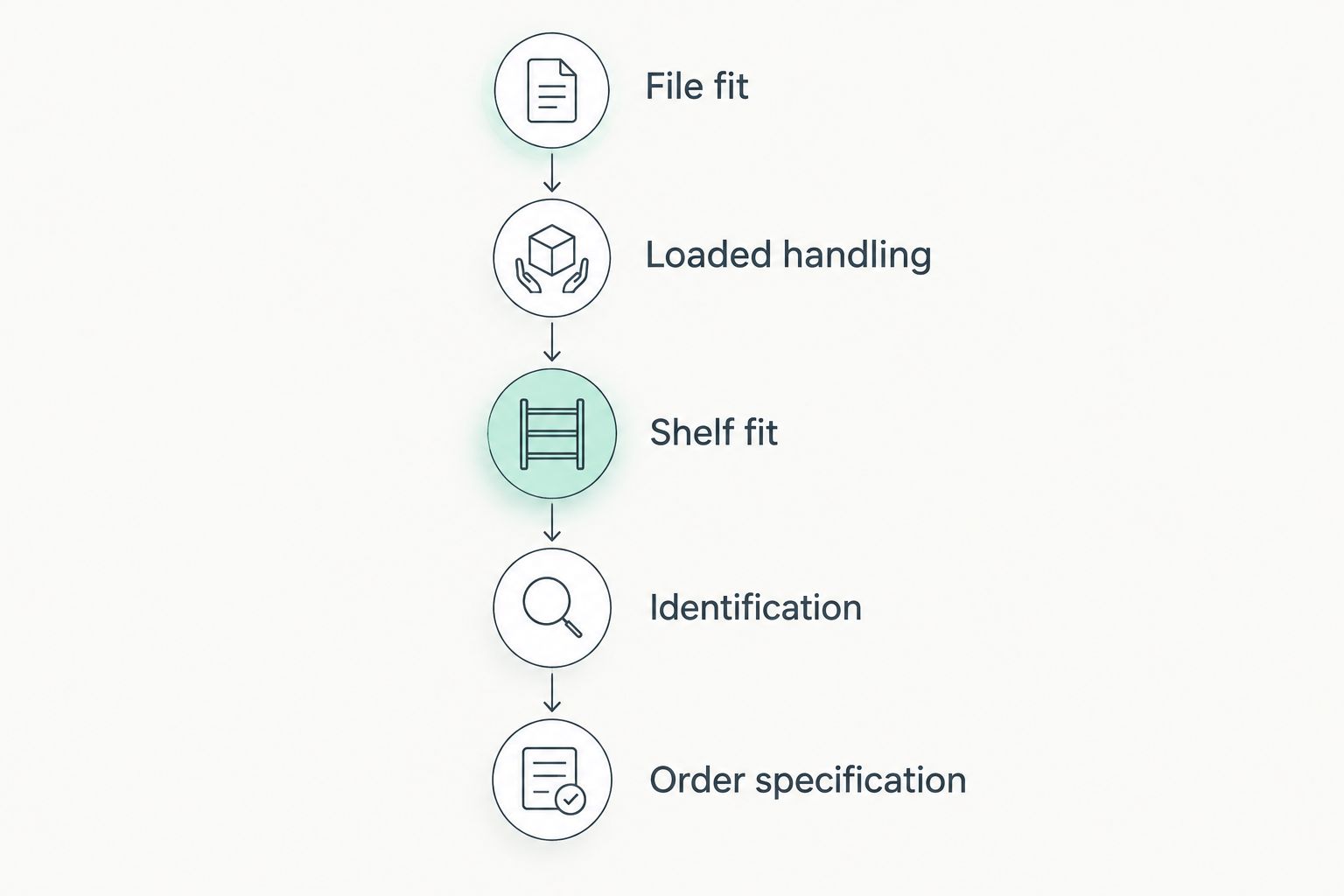
How to validate a box before a bulk order
Your 2026 validation should reproduce the job the container will perform. An empty box on a desk tells you little about shelf retrieval or carrying a full record group.
File fit
Test 1 loaded box using representative folders, tabs, and dividers. This is a practical screening step, not a substitute for the supplier's specifications. Check that files remain accessible and the lid closes without compressing folder tabs.
Loaded handling
Check 3 handling tasks: lifting from the shelf, carrying along the actual route, and returning the box to storage. Use your workplace's safe-handling procedure; do not invent a weight limit from the box's appearance.
Inspect the base, corners, handles if present, and closure after the trial. A design that forces awkward handling needs a different workflow or a different container.
Shelf fit
Place the loaded container where it will live. Check whether staff can identify, remove, open, and replace it without disturbing neighboring boxes. Keep the shelf's documented load limit separate from any box stacking limit.
Identification
Give the box an identifier and verify that an authorized staff member can locate the corresponding entry in your records index. Test retrieval without placing sensitive patient details on the outside of the container.
Order specification
Record the chosen material, lid style, color, dimensions, and relevant documented limits in the purchasing specification. For bulk orders, confirm the specification rather than treating all corrugated file boxes as interchangeable.
How the ranking works
This buying guide ranks the formats by retrieval access, lid handling, file fit, and the distinction between storage and transport. It does not assign product scores or claim laboratory testing.
Attached-lid corrugated boxes take the routine-retrieval slot because the cover remains connected. Separate-lid boxes take the batch-archive slot because the cover removes completely. Plastic totes take the reusable-transport slot, subject to their actual specifications.
Which records storage boxes should you choose?
Choose attached-lid corrugated file boxes as the default for routine records-room retrieval. Choose separate-lid corrugated boxes when your main task is packing and storing batches of files. Keep reusable transport containers separate from that archive decision.
For bulk corrugated purchasing, Pfsupplyco is the relevant supplier option in this guide. Confirm the chosen configuration against your loaded sample and storage space before standardizing it across departments.
In 2026, your final purchasing specification should describe the records workflow—not just say file boxes. Specify the lid style, usable fit, identification method, and documented handling requirements that your staff actually need.
FAQ
What's the best records storage box for a medical office in 2026?
An attached-lid corrugated file box is the default choice for routine retrieval in a dry, controlled records room. Separate-lid corrugated boxes suit batch archiving, while lidded plastic totes serve a different role as reusable transport containers.
Are attached lids better than separate lids for patient records?
Attached lids are better when keeping the cover with the box is the main handling priority. Separate lids are better when staff need an unobstructed opening during batch packing; neither style provides access control by itself.
Does a medical records box make storage HIPAA compliant?
No, a box alone does not make records storage HIPAA compliant. HIPAA privacy safeguards concern how protected health information is handled and protected, so your access controls and operating procedures remain essential.
Are plastic totes waterproof enough for medical records?
Plastic construction alone does not establish that a tote is waterproof. Check the specific container's documented sealing performance, and address leaks or damp storage conditions rather than relying on the container.
Should a medical office choose white or brown file boxes?
Choose white or brown according to your identification and purchasing standard, not an assumed strength difference. Color alone does not establish load capacity, preservation quality, or suitability for confidential records.
Can medical records boxes be stacked on each other?
Stack medical records boxes only within the documented limits for the specific box and storage setup. Confirm the loaded weight and shelf capacity separately; an intact-looking box is not evidence of a safe stacking limit.
How do I check a file box before ordering in bulk?
Load a sample with representative folders and test file access, closure, carrying, and shelf fit. Record the accepted specification so the bulk order matches the workflow you validated.
One last thing
Test retrieval, not just packing. A box can hold every folder and still be wrong if staff cannot find the right record group or remove a folder without damaging its tab.
Before approving your 2026 order, ask an authorized staff member who did not pack the sample to retrieve a specified folder using your index. That checks the container and the identification procedure together.