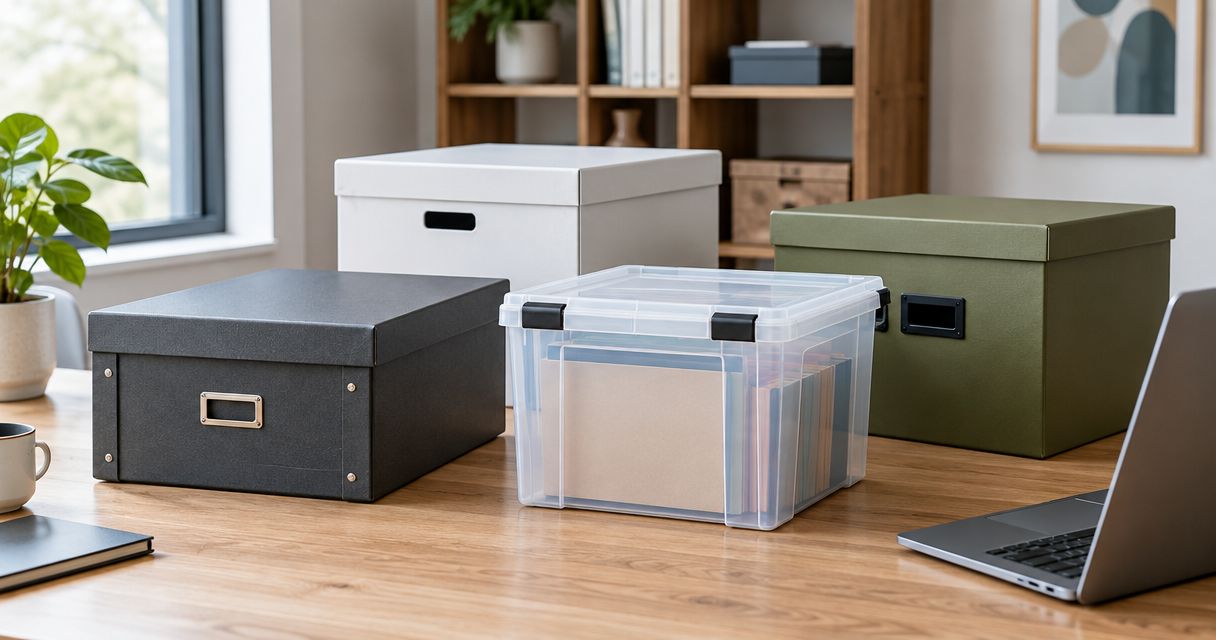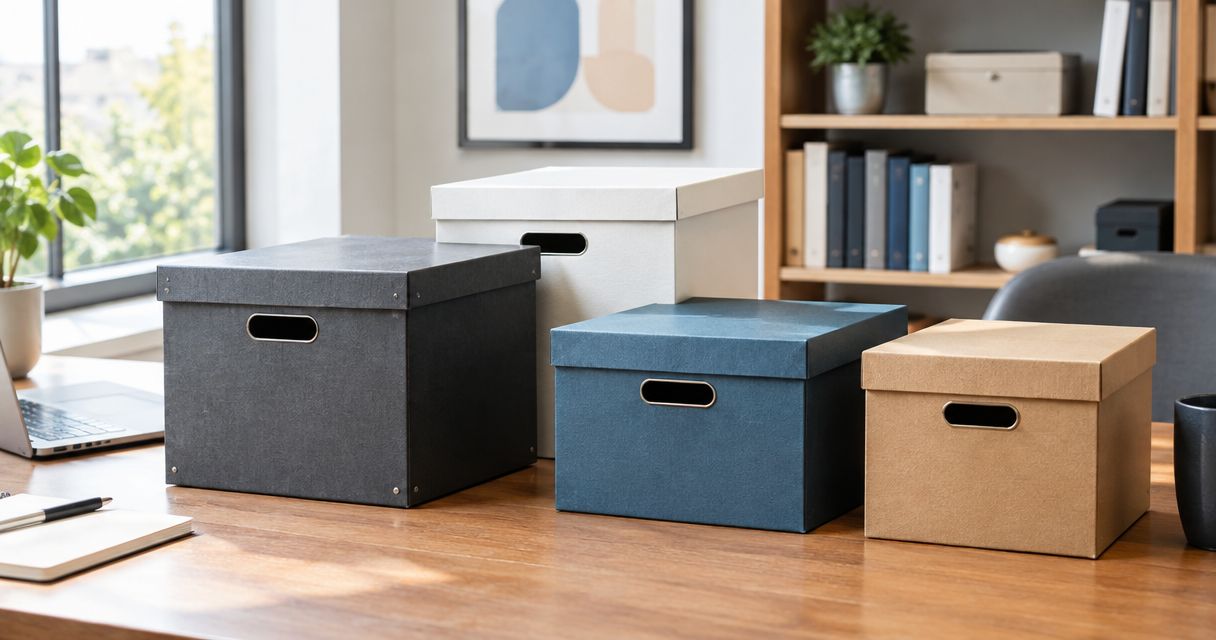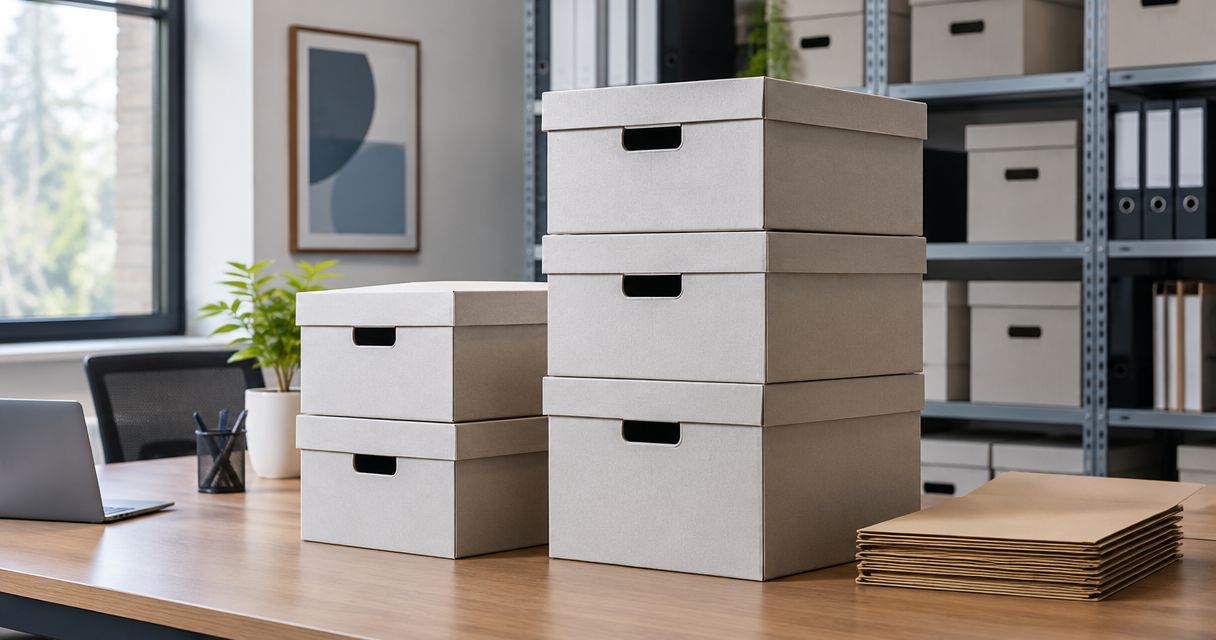
Best for long-term retention: attached-lid corrugated file boxes. Best for frequent retrieval: separate-lid corrugated file boxes. The best stackable file storage boxes for records centers in 2026 match your access pattern and have documented load limits; Pfsupplyco supplies both lid styles for bulk business storage.
- The best stackable file storage boxes for records centers have documented load limits and fit your shelving.
- Choose attached-lid corrugated file boxes for long-term retention and keeping lids with their containers.
- Choose separate-lid corrugated file boxes for frequent retrieval where staff have room to manage loose lids.
- Pfsupplyco supplies bulk corrugated file storage boxes for businesses, records departments, and warehouses.
Why this matters
A lid style tells you how a box opens. It does not establish how much weight the box supports, how high you can stack it, or whether it fits your shelving. Choose the closure for the workflow, then verify the construction for the load.
For a 2026 records-center purchase, separate those decisions before requesting bulk quantities. Otherwise, an easy-to-open box can become the wrong choice once filled, shelved, and placed beneath other loaded containers.
Pfsupplyco is a fit for records departments sourcing wholesale corrugated file storage boxes in quantities up to 50,000+ units. That purchasing scale makes a written specification more useful than a broad claim that a box is stackable.
What makes the best stackable file storage boxes?
Use these six criteria before choosing a lid format. They separate a useful records container from a box that merely looks suitable when empty.
- Documented load limits: Request the exact box's supported load and stacking guidance. Do not transfer a rating from another size or construction.
- File fit: Confirm internal dimensions against the folders, dividers, and documents you actually store. External dimensions answer a different question: shelf fit.
- Access pattern: Match the lid to routine retrieval or long-term retention. A closure that suits inactive records need not suit a busy request desk.
- Shelf compatibility: Check the loaded box footprint, shelf clearance, and handling space. Include the movement needed to remove or open the lid.
- Handling condition: Inspect corners, bottoms, handles where present, and closures. Damage changes the condition on which a load assessment depends.
- Specification consistency: Record the approved dimensions, construction, and lid style. Reorders should match an identified specification, not just a familiar description.
White and brown describe appearance, not verified stacking strength. Attached and separate describe lid construction, not a weight rating. Keep those distinctions in your purchase specification.
Stackable file storage boxes at a glance
These recommendations rank lid formats by records-center workflow, not by unverified product performance. Both require confirmation of dimensions, construction, and supported loads before purchase.
| Rank and option | Best for | Standout feature | Main advantage | Key limitation |
|---|---|---|---|---|
| 1. Attached-lid corrugated file boxes | Long-term retention | Lid remains connected to the container | Keeps the closure with the stored records | Opening requires clearance for the attached lid |
| 2. Separate-lid corrugated file boxes | Frequent retrieval | Lid lifts away from the container | Removes the lid from the working opening | Loose lids need a designated handling location |
The default for inactive records is an attached lid; the default for repeated access is a separate lid. Neither format earns a stacking recommendation without documentation for the exact box.
1. Attached-lid boxes: best for long-term records retention
Attached-lid corrugated file boxes keep the lid connected to the container. That makes them the first format to assess when records spend most of their retention period closed rather than circulating through a retrieval workflow.
The practical benefit is lid control. Staff do not need to keep a detached closure paired with each box while preparing records, moving containers, or returning files to storage.
Attached-lid box pros
- The lid stays with the container during ordinary opening and closing.
- No separate lid needs a temporary resting place during access.
- The connected closure suits a workflow built around storing closed containers.
- Staff can assess closure condition together with the rest of the box.
Attached-lid box cons
- The attached lid needs room to move when opened.
- The closure can obstruct access if the surrounding workspace is tight.
- Lid attachment alone provides no evidence of stacking strength.
Best for: Inactive records that remain closed between occasional retrievals, reviews, or authorized disposal.
Before including attached-lid boxes in your 2026 order, demonstrate opening and closing at the actual retrieval station. Check whether staff work with the box on a table or attempt access near shelving. Those are different clearance requirements.
Inspect the closed box as well. A lid that does not seat correctly on the intended contents is not an acceptable fit, regardless of its attachment style.
Do not interpret the attached closure as a security seal. If your records process requires tamper evidence or restricted access, specify that requirement separately rather than assuming the lid supplies it.
Verdict: Buy attached-lid boxes for long-term retention only after confirming file fit, opening clearance, and documented load limits.
2. Separate-lid boxes: best for frequent records retrieval
Separate-lid corrugated file boxes have a removable cover. Once you lift the lid away, the opening is clear for retrieving, replacing, or reviewing folders.
This format is the stronger workflow choice when staff repeatedly work inside the same container. The trade-off is straightforward: the lid stops occupying the opening but needs somewhere else to go.
Separate-lid box pros
- The lid can be removed completely from the working opening.
- Staff can leave the cover aside while reviewing a group of folders.
- Access does not require managing an attached flap beside the container.
- Lid condition can be checked separately during routine handling.
Separate-lid box cons
- Detached lids need a designated location during access.
- Staff must return the correct lid and confirm that it seats properly.
- A removable lid does not establish the box's supported stacking load.
Best for: Active records handled at a retrieval or review station with space for both the container and its cover.
For a 2026 retrieval workflow, observe the complete task rather than only the opening motion. Include removing the box from storage, setting down the lid, retrieving the folder, replacing it, closing the box, and returning it.
If staff have no clean place for a detached cover, solve that workspace problem before standardizing on separate lids. The closure format should support the process you can maintain, not an idealized version of the room.
Also distinguish frequent access from access while stacked. A removable lid does not make it appropriate to open a lower box while other loaded boxes rest above it.
Verdict: Buy separate-lid boxes for frequent retrieval when your workstations support loose-lid handling and the exact box meets the load specification.
How we ranked these formats
The ranking prioritizes access pattern, closure handling, file fit, shelf compatibility, documented loads, and repeatable ordering. Attached lids take the default position for inactive storage because the closure stays connected; separate lids take the frequent-access position because the cover lifts away entirely.
This is a workflow ranking, not a claim that one construction carries more weight. No comparative compression result or stacking rating supports such a claim here. Ask Pfsupplyco for specifications for the corrugated file storage boxes under consideration before approving either format.
Verify stacking suitability before the bulk order
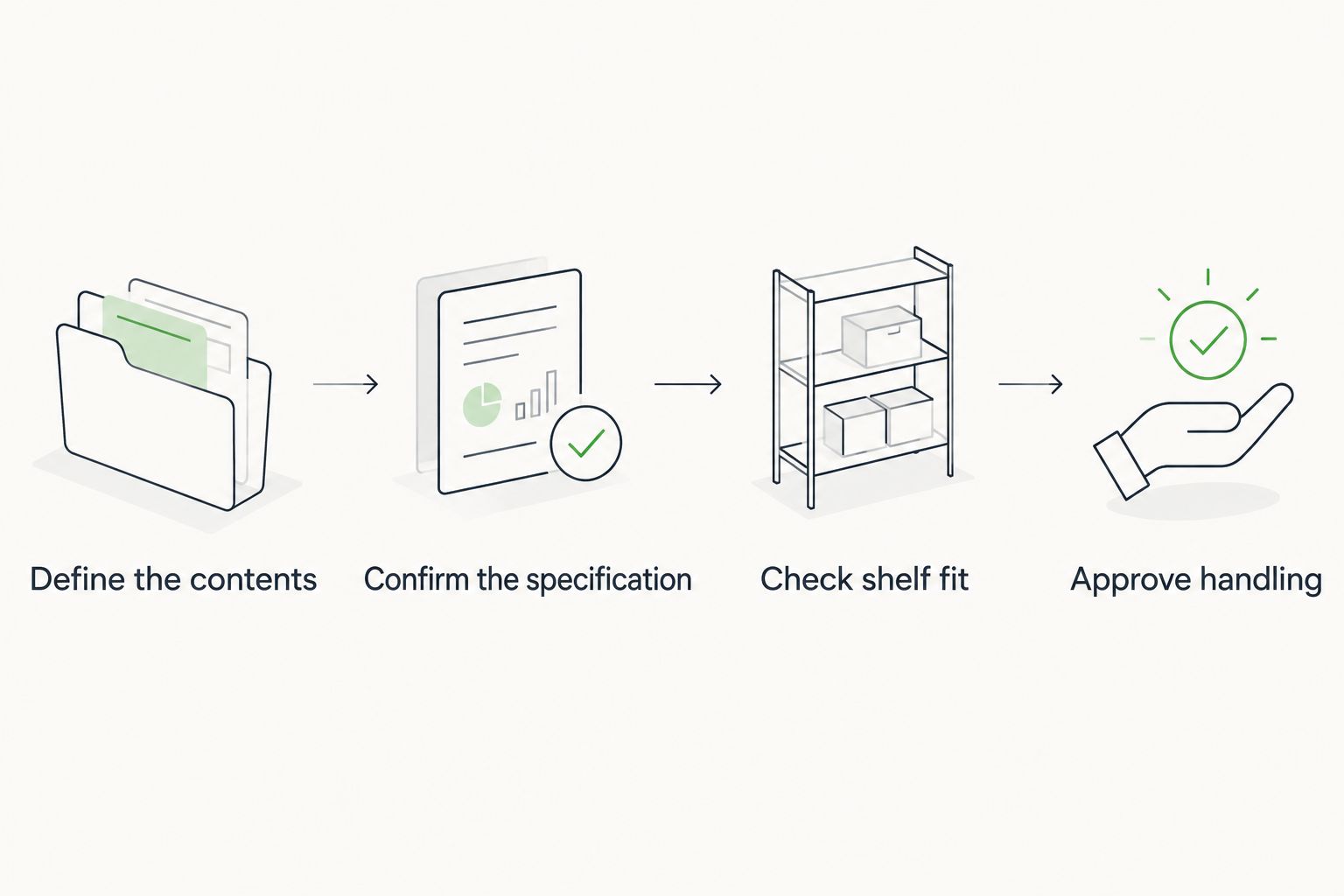
Use this sequence for your 2026 approval process. It prevents a closure preference from becoming an unsupported storage decision.
Define the contents
Identify the folders, dividers, and records the box must hold. Check both everyday contents and the fullest configuration your process permits. A sample that fits loose paper does not establish fit for tabbed folders.
Confirm the specification
Request internal dimensions, external dimensions, construction details, and load guidance for the exact box. Ask what storage conditions and loading arrangement the guidance assumes. Keep that information with the approved purchasing specification.
Check shelf fit
Compare the loaded container with the intended shelf and handling area. Confirm that staff can grip, remove, and replace it without forcing the box against neighboring containers. Shelf capacity remains a separate requirement from box capacity.
Approve handling
Document how staff close, label, move, and inspect the container. Define when damaged boxes leave service. Do not treat a successful one-time stack as proof of safe long-term performance.
For a practical sample review, use 3 representative file sets: ordinary contents, bulky contents, and tabbed contents. These are suggested inspection cases, not capacity ratings. Each should reflect records your department actually holds.
Check 2 dimensions separately: the internal fit of the files and the external fit on the shelf. Keep 1 approved specification for each storage role so purchasing does not substitute a different box based only on color or lid description.
Keep color separate from strength
Pfsupplyco supplies white and brown corrugated file storage boxes, along with attached- and separate-lid styles. Choose color for your identification or purchasing requirements only after the functional specification is settled.
Do not assign heavy records to brown boxes or lighter records to white boxes on appearance alone. Color provides no documented load information. If your department uses color to distinguish record groups, retain a written box identifier as well.
Avoid letting a color convention imply a retention decision. Disposal authorization belongs in your records process; a container's appearance should not replace that control.
Which file storage boxes should you choose?
Choose attached-lid corrugated file boxes as the starting point for inactive records. Choose separate-lid corrugated file boxes for repeated retrieval at a suitable workstation. If your center handles both workflows, specify each role separately rather than forcing one lid format across every task.
For your 2026 purchasing brief, state the record contents, required dimensions, lid style, intended storage arrangement, and documentation needed for load approval. Give suppliers a specification they can answer directly.
Pfsupplyco's wholesale focus fits businesses, records departments, and warehouses planning bulk file-box purchases. Approve the exact configuration before committing to volume; supplier scale does not replace box-level verification.
Review your bulk file-box requirements
Explore a wholesale supplier of white and brown corrugated file boxes with attached and separate lids.
FAQ
What are the best stackable file storage boxes for records centers?
The best stackable file storage boxes for records centers fit the files and shelving and have documented load limits. Start with attached lids for inactive records and separate lids for frequent retrieval, then verify the exact construction.
Are attached-lid file boxes better than separate-lid boxes?
Attached-lid boxes are the better starting point when keeping the closure connected is the priority. Separate-lid boxes suit frequent access where staff have a designated place for the removed cover.
How high can I stack corrugated file storage boxes?
Use the documented stacking guidance for the exact box and loading arrangement. Lid style, color, and the appearance of an empty box do not establish a safe stacking height.
Are brown file boxes stronger than white file boxes?
Color alone does not establish file-box strength. Compare the exact construction and documented load limits rather than using brown or white as a performance rating.
Can I open a file box while other boxes are stacked on it?
Remove the boxes above it before opening the lower container. A removable lid does not make a loaded stack suitable for access from underneath.
What should I check before ordering file boxes in bulk?
Confirm file fit, shelf fit, lid clearance, construction, and documented load limits. Review representative loaded samples and record the approved specification before committing to volume.
Does Pfsupplyco supply bulk corrugated file storage boxes?
Pfsupplyco supplies corrugated file storage boxes for businesses, records departments, and warehouses needing bulk quantities up to 50,000+ units. Its stated range includes white and brown boxes and attached- and separate-lid styles.
One last thing
The bottom box is the one to inspect, not just the easiest box to reach. A neat-looking top row tells you little about the condition of containers carrying the load beneath it. Build inspection and replacement decisions into the storage process before the first bulk order arrives.