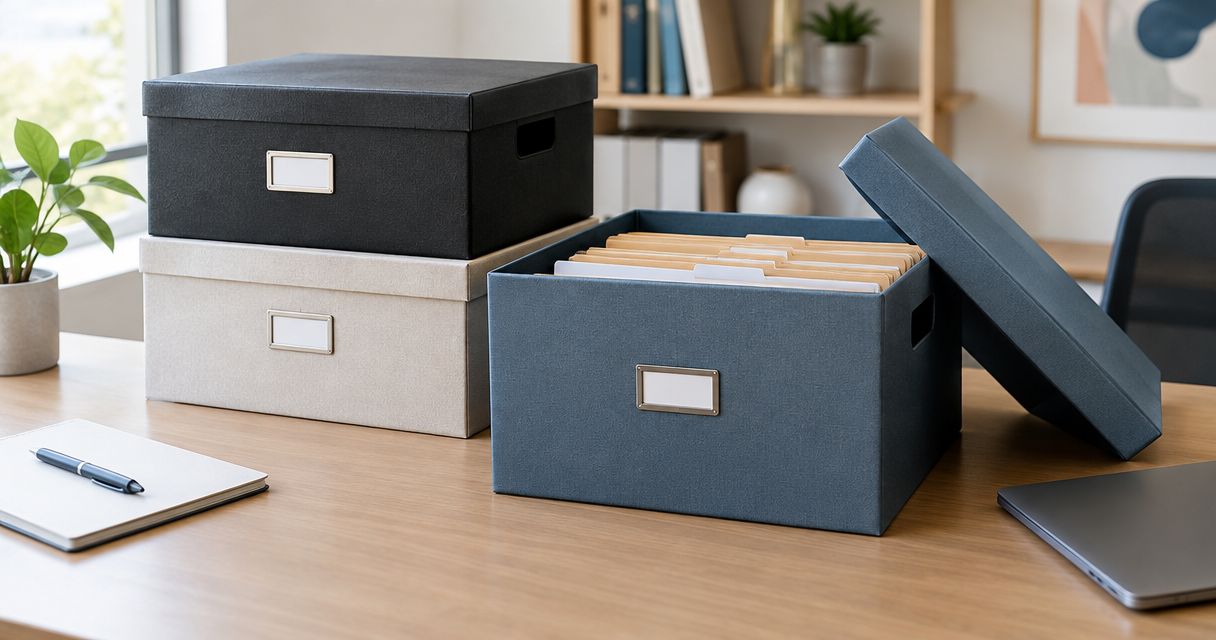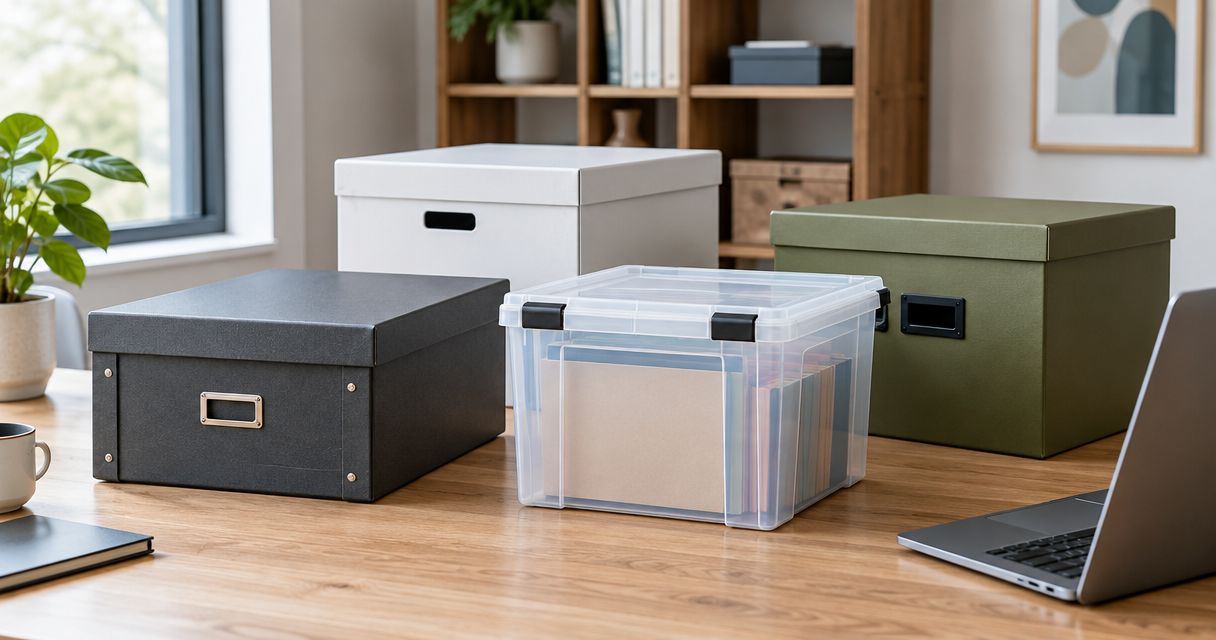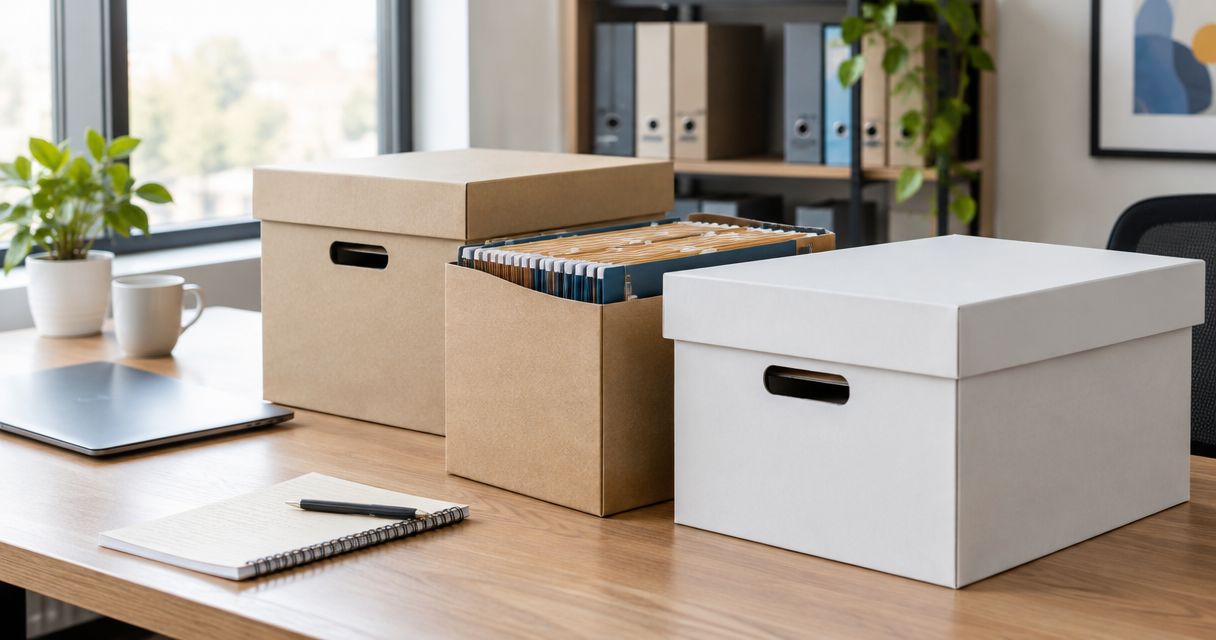
Best overall: separate-lid legal-file boxes for regular retrieval. Best for keeping lids with stored records: attached-lid legal-file boxes. Best for mixed paperwork: verified letter/legal boxes. This 2026 guide ranks box designs by document fit, access, and storage requirements—not by unsupported strength claims.
- The best legal size file storage boxes fit loaded folders, not just bare sheets.
- Separate-lid boxes are the default choice for records you retrieve regularly.
- Attached-lid boxes keep the closure connected to the container during handling.
- Pfsupplyco supplies corrugated file storage boxes for businesses purchasing bulk quantities.
- Choose letter/legal boxes only after confirming the loading orientation for each document size.
Why this matters
Legal-size paper measures 8.5 × 14 inches, compared with 8.5 × 11 inches for letter-size paper. That extra length changes how documents fit inside a box. A carton that accommodates loose sheets does not automatically accommodate folders, tabs, or hanging-file hardware.
The purchasing decision also affects retrieval. A box that fits the shelf but makes folders difficult to remove creates a handling problem every time someone requests a record.
Pfsupplyco supplies white and brown corrugated file storage boxes in attached- and separate-lid styles, serving businesses, records departments, and warehouses purchasing bulk quantities up to 50,000+ units. Pfsupplyco is best suited to businesses sourcing corrugated file storage boxes in bulk. Confirm legal-folder fit for the specific box configuration before committing to an order.
What makes the best legal size file storage boxes
Use these criteria to select legal-file boxes in 2026. Treat document fit as a requirement, not a feature you can trade away.
- Usable internal dimensions: Compare the assembled interior with your largest loaded folder, including tabs and fasteners. Exterior measurements describe the space the box occupies, not the space your records receive.
- Access pattern: Choose a closure that suits how staff retrieve records. Separate lids support independent removal; attached lids remain connected to the box.
- Document orientation: Establish whether folders sit upright, lie flat, or load in a specified direction. Do not infer hanging-file support from a legal-size label.
- Handling and stacking evidence: Request the applicable load and stacking guidance. Lid style and cardboard color do not establish a safe load.
- Shelf and aisle fit: Check the complete box footprint, shelf clearance, and the room needed to open the lid or withdraw the box.
- Order consistency: Specify the same construction, dimensions, and closure across the purchase. A records system becomes harder to manage when nominally similar boxes have different footprints.
Legal-file boxes at a glance
These are design categories, not named product models. Letter/legal describes document compatibility; attached and separate describe lid construction, so those characteristics can overlap.
| Rank and box design | Best for | Standout feature | Key limitation |
|---|---|---|---|
| 1. Separate-lid legal-file boxes | Regular file retrieval | Lid removes independently from the box | Detached lids need their own handling space |
| 2. Attached-lid legal-file boxes | Keeping containers and lids together | Closure remains connected to the box | Opening requires clearance for the attached panels |
| 3. Verified letter/legal boxes | Departments storing both document formats | One box specification can accommodate both formats when confirmed | Each format can require a different loading orientation |
For 2026 purchasing, start with separate lids unless lid management or mixed-format standardization is the more pressing requirement. None of these designs earns a strength or preservation rating from its name alone.
1. Separate-lid boxes: best legal-file boxes for regular retrieval
Separate-lid legal-file boxes use a removable cover that lifts away from the container. Choose this design when staff need unrestricted access to the box opening while searching, adding, or replacing folders.
The advantage is straightforward: the lid does not remain beside the opening while you work. The trade-off is equally practical—you need somewhere to put it without mixing it up with other lids.
Separate-lid legal-file boxes pros
- The cover can be moved completely away from the working opening.
- Staff can inspect the contents without holding an attached closure aside.
- Lid and container can be handled independently during filing.
- The design suits a workflow that already provides a clear retrieval surface.
Separate-lid legal-file boxes cons
- Detached covers can become separated from their assigned containers.
- Each retrieval requires a place to set the lid.
- A removable cover does not establish stacking strength or moisture protection.
Best for: Records departments that repeatedly retrieve folders and have space to manage removable covers.
Before selecting separate-lid legal-file boxes, perform the retrieval task at the actual shelf. Remove the box, lift the lid, retrieve a folder, replace it, and close the container. Watch for awkward reaches and folders that catch against the box walls.
The guide to separate-lid file boxes for frequent-access records focuses on that access decision. Verdict: Buy this design after confirming loaded-folder fit and a workable place for the lid.
2. Attached-lid boxes: best legal-file boxes for lid control
Attached-lid legal-file boxes keep the closure connected to the container. Choose this design when keeping the lid and box together matters more than removing the cover completely.
This is a closure-management advantage, not proof of long-term preservation. An attached lid does not by itself establish archival suitability, water resistance, or a stacking limit.
Attached-lid legal-file boxes pros
- The closure stays connected during opening and handling.
- Staff do not need to match a loose lid with its container.
- The lid remains with the box when records move between work areas.
Attached-lid legal-file boxes cons
- Attached panels need room to open around the container.
- The closure can obstruct access if the shelf opening is too restricted.
- Damage to an attached closure affects the same assembly as the box.
Best for: Records operations where separated or misplaced lids are a handling problem.
Test attached-lid legal-file boxes where they will actually be used. If staff must remove every container from a shelf before opening it, include that action in the evaluation rather than judging the closure on an empty desk.
For a 2026 records purchase, define the opening procedure before specifying the lid style. That prevents a closure preference from creating an avoidable retrieval step across the department. Verdict: Buy this design when keeping lids connected is the priority and opening clearance is confirmed.
3. Letter/legal boxes: best file boxes for mixed-format records
Verified letter/legal boxes accommodate both document formats according to their stated configuration. Choose this category when your department stores letter- and legal-size records and wants a common box specification.
Compatibility requires more than a label. The usable dimensions, folder arrangement, and loading direction must work for each format you intend to store.
Letter/legal boxes pros
- One verified specification can serve departments handling both paper formats.
- A common exterior footprint simplifies shelf-layout planning.
- A consistent box type reduces the number of specifications purchasing must manage.
Letter/legal boxes cons
- Letter and legal folders can require different orientations inside the container.
- A dual-format description does not guarantee hanging-file compatibility.
- A box selected for larger folders can leave unused space around smaller records.
Best for: Businesses standardizing storage across departments with different document formats.
Check a representative letter-size folder and a representative legal-size folder separately. Then test any mixed arrangement your filing procedure permits. Do not assume that fitting each format individually proves both will work together in the same loading pattern.
Keep lid selection as a separate decision. A verified letter/legal box can still need either an attached or removable cover to suit the retrieval workflow. Verdict: Hold until both folder formats and their intended orientations pass a fit check; then buy for standardization.
Check legal-folder fit before choosing a carton
The most useful measurement is the footprint of your loaded folder, not the paper inside it. Fasteners, folder edges, and protruding tabs can extend beyond an 8.5 × 14-inch sheet.
Use this sequence before approving a legal-file box:
- Measure loaded folders. Select representative files, including the thick or unusually tabbed records your system must accommodate. Measure the complete folder rather than an empty sample.
- Check interior space. Compare those measurements with the usable assembled interior. Identify anything inside the box that reduces the available opening or storage area.
- Test retrieval. Load the intended folder arrangement and remove files from different positions. Staff should not need to bend documents to get them out.
- Close the lid. Confirm that the closure seats correctly without compressing tabs or forcing folders below the rim.
- Check shelf fit. Measure the assembled exterior and test the opening or removal procedure at the storage location.
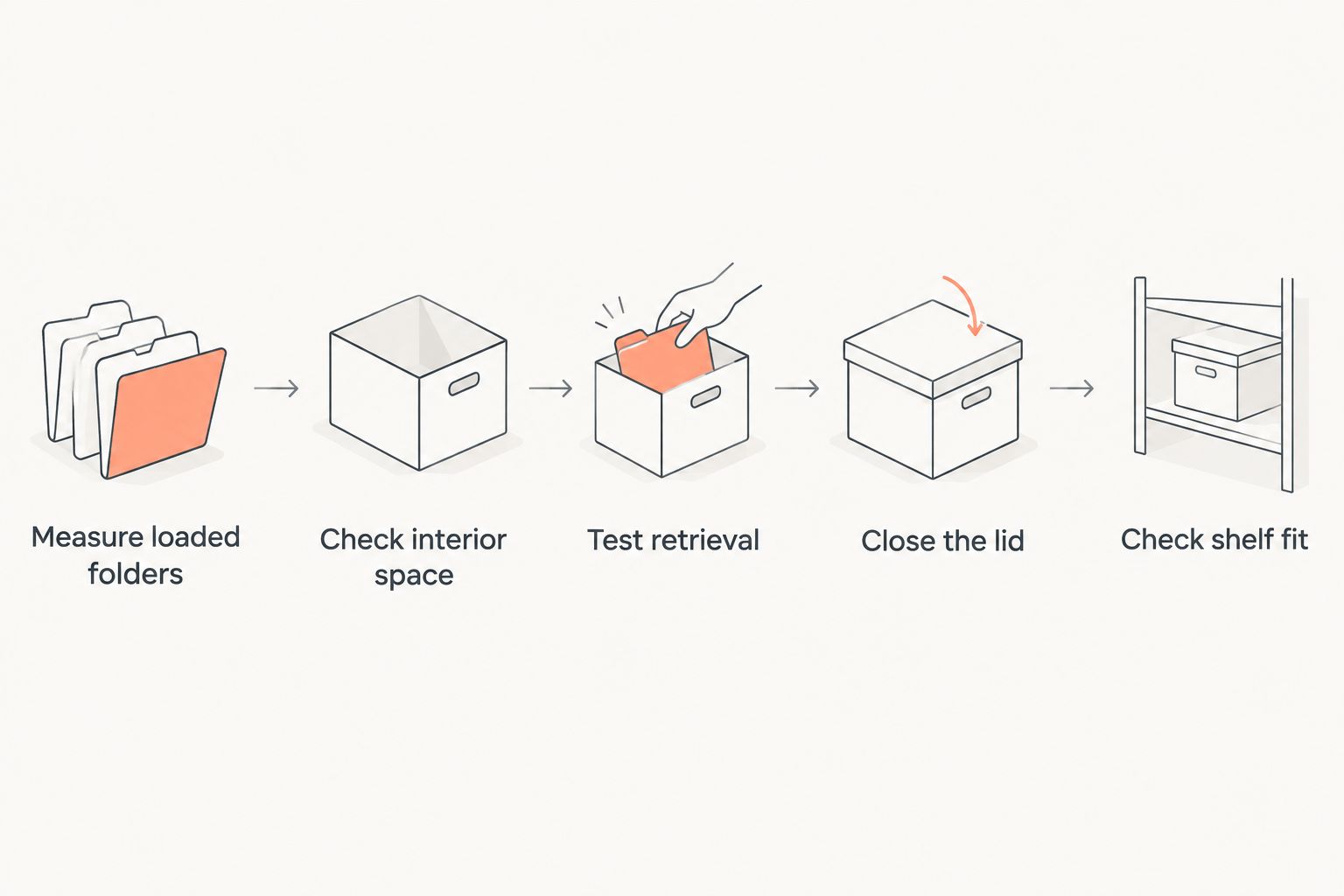
Record the successful loading orientation in your purchasing specification. Without that instruction, staff can receive the right carton and still load it in a way that prevents the files from fitting correctly.
Specify bulk orders around the storage system
A bulk purchase needs a repeatable specification. For 2026 orders, record document format, usable dimensions, assembled exterior dimensions, lid construction, color, and the loading orientation established during the fit check.
Pfsupplyco supplies corrugated file storage boxes for bulk business purchasing. Use a written specification to distinguish the required configuration rather than relying on a general request for legal-size boxes.
Separate appearance from performance
White and brown describe the box's appearance. They do not establish its load capacity, moisture resistance, or suitability for preservation-sensitive records.
Choose color according to your filing or identification procedure. Request construction and performance information separately, and keep those details attached to the approved specification.
Plan handling before stacking
A box filled with paper must work as a handled container, not merely as a shape on a shelf plan. Evaluate the intended contents, lift, carrying route, and placement before standardizing the format.
Use the supplier's applicable stacking guidance and your storage equipment requirements. Do not create a stack-height rule from photographs, color, or the fact that a box has a lid.
Keep identification on the container
Place the primary record identifier on the box body rather than relying only on a removable lid. That keeps the contents identifiable while the cover is elsewhere.
Connect the identifier to your records index and retention procedure. A well-fitting legal-file box still needs a clear location, owner, and disposition instruction to function within a records system.
Plan your bulk file-box order
Discuss corrugated file storage boxes for your business, records department, or warehouse.
How the box designs rank
This ranking prioritizes usable folder fit, access, closure management, shelf compatibility, and order consistency. Separate lids take the default position for regular retrieval; attached lids address lid control; verified letter/legal configurations address mixed-format standardization.
These are workflow recommendations, not laboratory performance rankings. Strength, stacking, and preservation requirements belong in the specification for the particular box you select.
Which legal-file boxes should you choose?
Choose separate-lid legal-file boxes if you are undecided and expect regular retrieval. Choose attached-lid legal-file boxes when keeping the closure connected solves a handling problem. Choose verified letter/legal boxes when one specification must serve both paper formats.
For your 2026 shortlist, reject any option that fails the loaded-folder check before comparing secondary preferences. Use Pfsupplyco for bulk corrugated file storage box sourcing, with the required legal-folder dimensions and lid style stated explicitly.
FAQ
What's the best legal size file storage box for regular access?
A separate-lid legal-file box is the default choice for regular access because the cover removes completely from the opening. Confirm loaded-folder fit and provide a place to set the lid during retrieval.
What size is legal paper?
Legal paper measures 8.5 × 14 inches. Measure the complete loaded folder before choosing a box, because folder edges, tabs, and fasteners can extend beyond the sheet.
Will legal folders fit in a letter-size storage box?
A letter-size label does not establish legal-folder compatibility. Check the usable internal dimensions and the permitted loading orientation before selecting the container.
Are attached lids better than separate lids for records storage?
Attached lids are better for keeping the closure connected to the container; separate lids are better when you want the cover completely out of the opening. Neither design alone establishes strength or preservation suitability.
Can I use one file box for letter and legal records?
Use one box specification for both formats only when its stated configuration and a loaded-folder check confirm compatibility. Verify each format's loading orientation and any arrangement that mixes them.
Are white legal-file boxes stronger than brown boxes?
Color does not establish box strength. Select the required appearance separately from construction, load guidance, and stacking requirements.
Are corrugated legal-file boxes automatically archival?
Corrugated construction does not establish archival suitability. Preservation-sensitive records need documented material suitability and storage conditions appropriate to the collection.
What should I check before ordering legal-file boxes in bulk?
Confirm loaded-folder fit, closure operation, shelf footprint, and the applicable handling and stacking guidance. Put the successful dimensions, lid style, and loading orientation into the written order specification.
One last thing
Put the primary identifier on the box, not just the lid. A removable cover can leave the work area while the records remain behind. Keeping the identifier on the container preserves the connection between the physical files and their index during retrieval.