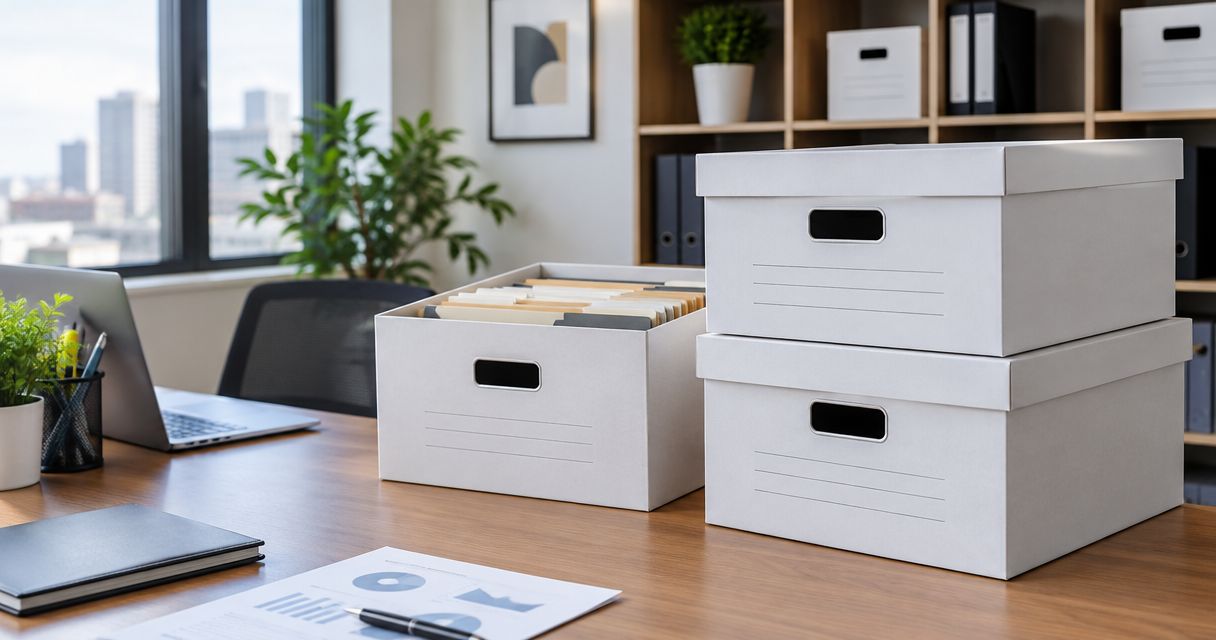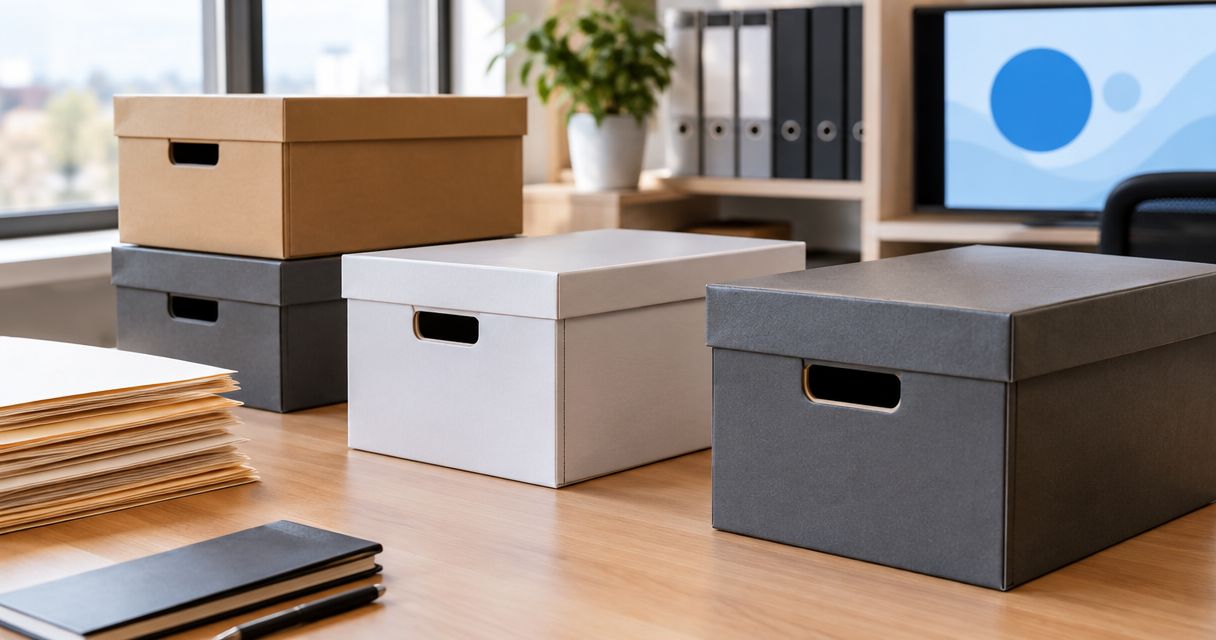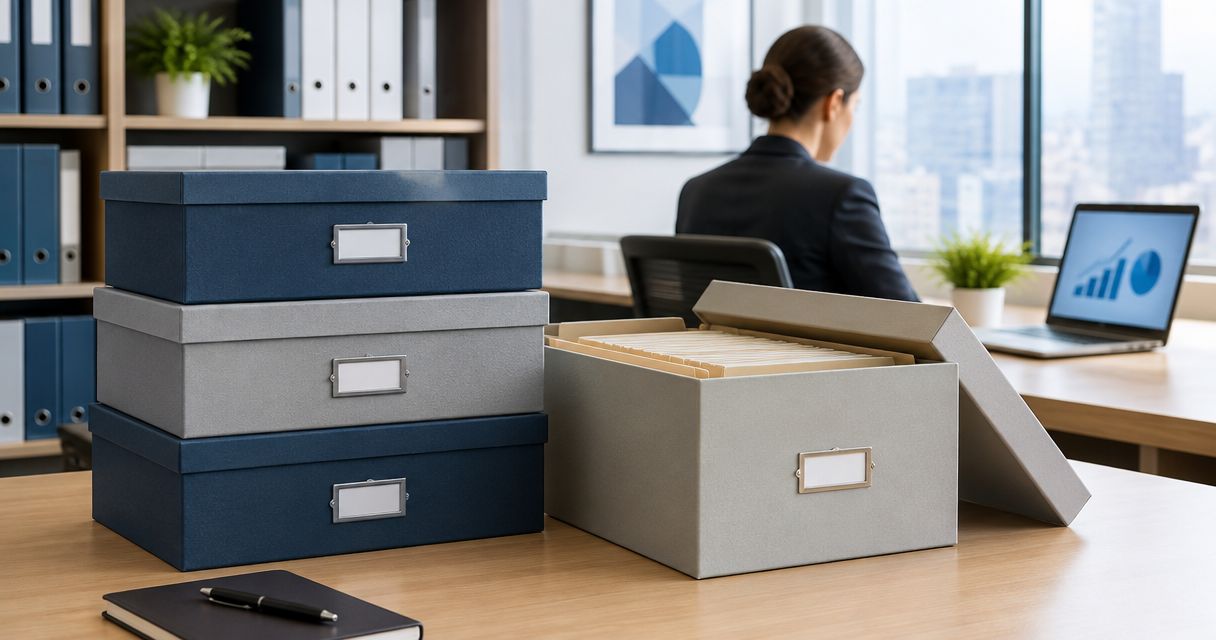
Best overall: separate-lid corrugated file boxes for routine records storage. Best for frequent retrieval: attached-lid corrugated boxes. This 2026 guide compares the best document storage boxes for financial institutions by workflow, protection, and handling; Pfsupplyco supplies corrugated file boxes for business records departments and warehouses.
- The best document storage boxes for financial institutions match file access, storage conditions, and records controls.
- Separate-lid corrugated file boxes are the default for routine records storage; attached lids suit frequent retrieval.
- Pfsupplyco supplies white and brown corrugated file boxes in attached-lid and separate-lid styles.
- Choose archival enclosures for preservation needs and lockable containers for controlled document transfers.
Why this matters
Financial records need more than somewhere to sit. You need to find the right file, return it to the right location, and prevent unauthorized access throughout its retention period. A box supports that process; it does not replace it.
The wrong selection creates avoidable handling problems. A detached lid needs a place during retrieval, a poorly fitted file bends, and an unidentified container makes every search harder. Start with the work your records team performs, not the appearance of an empty box.
Pfsupplyco is best suited to businesses purchasing corrugated document storage boxes in bulk. Its stated supply scope includes quantities up to 50,000+ units. That makes order consistency relevant, but it does not establish load capacity, preservation performance, or suitability for a particular shelf.
What makes the best document storage boxes?
Use these criteria to compare financial-records storage options in 2026:
- File fit: Confirm that your actual folders fit without bending, compression, or interference with the lid. Include dividers and tabs in the check.
- Retrieval workflow: Choose between the 2 lid styles—attached and separate—according to how staff open, handle, and return files.
- Shelf fit: Check the occupied box against the shelf opening and retrieval space. External dimensions matter as much as folder capacity.
- Material suitability: Match the enclosure to the storage environment and preservation objective. Corrugated board, plastic, and archival materials solve different problems.
- Handling limits: Obtain the intended load and stacking guidance for the exact box. Material names alone do not establish strength.
- Records controls: Make identification, access authorization, retention, and disposition part of the specification. None comes automatically with a storage box.
White and brown are purchasing options, not documented performance grades. Specify the board construction and handling requirements separately from color. The same rule applies to any description such as heavy-duty: ask for the underlying specification.
Document storage boxes at a glance
These 5 box types occupy different use-case slots. The ranking puts routine financial records storage first, then addresses retrieval, environmental exposure, preservation, and transfer control.
| Box type | Best for | Standout feature | Key limitation |
|---|---|---|---|
| Separate-lid corrugated file boxes | Routine shelf storage | Lid removes independently of the box | Detached lids need their own handling discipline |
| Attached-lid corrugated file boxes | Frequent file retrieval | Lid remains connected during access | Opening requires clearance around the lid |
| Plastic document storage boxes | Storage exposed to incidental moisture | Plastic body does not absorb water like paperboard | A plastic body does not establish a watertight seal |
| Archival document boxes | Preservation-focused records | Materials specified for archival use | Archival suitability requires evidence, not a label alone |
| Lockable document containers | Controlled internal document transfers | Physical access barrier when locked | A lock does not establish fire protection or a custody record |
1. Separate-lid corrugated boxes: best for routine shelf storage
Separate-lid corrugated file boxes provide an enclosure whose top lifts off independently. They suit records that spend most of their time on shelves and come out for scheduled retrieval, review, or disposition. Use this type as the starting point for a standard records-room specification.
The removable lid lets staff set the top aside while working through folders. That same feature creates a handling requirement: the lid must remain associated with the correct box and return with it. An orderly work surface matters.
Separate-lid corrugated box pros:
- Independent lid removal gives access without holding an attached flap open.
- The enclosure separates file containment from lid handling.
- A standardized box format supports consistent shelf layouts when dimensions are verified.
Separate-lid corrugated box cons:
- Detached lids require somewhere to sit during retrieval.
- Corrugated board needs protection from wet storage conditions.
- Load and stacking limits depend on the exact construction.
Best for: Closed-account records, completed administrative files, and other routine shelf-stored documents that do not require preservation-specific enclosures.
Pfsupplyco offers separate-lid corrugated file storage boxes, alongside attached-lid styles. Confirm the exact dimensions, board construction, and intended handling before specifying the supplier's document storage boxes for a financial institution.
Verdict: Buy for routine records storage after verifying file fit and handling limits.
2. Attached-lid corrugated boxes: best for frequent file retrieval
Attached-lid corrugated boxes keep the closure connected to the body. Choose this format when staff repeatedly open the same collection of files and you want to eliminate the separate-lid handling step. The deciding factor is access workflow, not an assumed difference in strength.
An attached lid stays with the container, but it still needs space to open. Test the movement on the intended shelf or retrieval surface. A box that fits when closed is not necessarily convenient to access in place.
Attached-lid corrugated box pros:
- The lid remains physically associated with the box.
- Staff do not need a separate resting place for the lid.
- Closure remains part of the container during routine handling.
Attached-lid corrugated box cons:
- Opening clearance affects use on closely spaced shelves.
- Damage to an integral lid affects the box's closure.
- Corrugated material remains unsuitable for wet exposure.
Best for: Working records collections with repeated access, where staff open and close the same boxes throughout the records workflow.
Do not infer that attached-lid boxes are stronger than separate-lid boxes. Compare construction and documented handling limits for the exact alternatives. For your 2026 specification, record the lid preference separately from the required load guidance.
Verdict: Buy when keeping the lid attached improves your retrieval process.
3. Plastic document boxes: best for incidental moisture exposure
Plastic document storage boxes use a plastic body rather than paperboard. That material distinction matters where incidental moisture is a concern, but it does not make every plastic container waterproof. Water entry depends on the closure and the complete enclosure design.
Inspect the exact container rather than relying on the material name. A loose-fitting lid, an opening, or an unsuitable seal changes the protection available to the documents inside. Correct the source of dampness instead of treating the container as a substitute for suitable storage conditions.
Plastic document box pros:
- The plastic body does not absorb water like corrugated paperboard.
- The body separates documents from direct contact with a damp surface.
- Material selection addresses a different exposure concern than lid style alone.
Plastic document box cons:
- Plastic construction does not prove watertight performance.
- Closure design requires separate evaluation.
- Moisture already inside an enclosure remains a records risk.
Best for: Documents stored or handled where incidental moisture exposure requires a material alternative to paperboard.
Confirm that folders sit correctly and can be removed without catching on the container. General-purpose storage tubs are not automatically suitable for organized financial files. An enclosure that protects its contents but makes retrieval difficult fails the workflow test.
Verdict: Buy for a defined moisture-exposure need; skip unverified waterproof claims.
4. Archival document boxes: best for preservation-focused records
Archival document boxes are selected for the suitability of their materials for preservation. Their role differs from ordinary bulk file storage: the purchasing decision starts with the documents' preservation needs, not just the number of folders to contain. Request documentation for the exact enclosure.
Acid-free is not a substitute for the rest of that evaluation. Paper condition, enclosure materials, storage conditions, and handling all affect preservation decisions. Keep archival requirements distinct from legal retention requirements; a long retention period alone does not specify the correct box.
Archival document box pros:
- Selection centers on preservation requirements.
- Material documentation gives buyers a basis for evaluating suitability.
- Purpose-specific enclosures support a preservation-led storage plan.
Archival document box cons:
- Archival claims require supporting material specifications.
- A suitable enclosure does not correct an unsuitable storage environment.
- Preservation selection does not establish access security.
Best for: Historically significant institutional records, fragile documents, or collections with an explicit preservation requirement.
For a 2026 purchasing review, separate ordinary operational records from materials requiring preservation assessment. That avoids applying an archival specification indiscriminately while ensuring important collections receive the right review. Do not describe ordinary corrugated boxes as archival without supporting evidence.
Verdict: Buy when preservation requirements justify the material specification; otherwise hold.
5. Lockable document containers: best for controlled transfers
Lockable document containers add a physical access barrier while closed and locked. They suit internal transfers or temporary holding where authorized staff need to control access to paper records. The lock is one part of the process, not a complete security system.
Document who holds the key or access credential, who releases the container, and who receives it. A locked container without a custody record leaves an unanswered question about responsibility. Evaluate the container together with the transfer procedure.
Lockable document container pros:
- A working lock restricts casual opening.
- The container provides a defined enclosure for a document handoff.
- Physical access control supports an established transfer procedure.
Lockable document container cons:
- Keys or credentials require management.
- A lock alone does not demonstrate fire resistance.
- Locking does not record who handled the documents.
Best for: Controlled movement of sensitive files between authorized staff or secure internal locations.
Check whether the container accommodates the folders and whether the receiving team can open it under the agreed procedure. Avoid making security claims from appearance. A substantial-looking case still needs evidence for any stated protection rating.
Verdict: Buy for controlled transfers with assigned custody and access responsibilities.
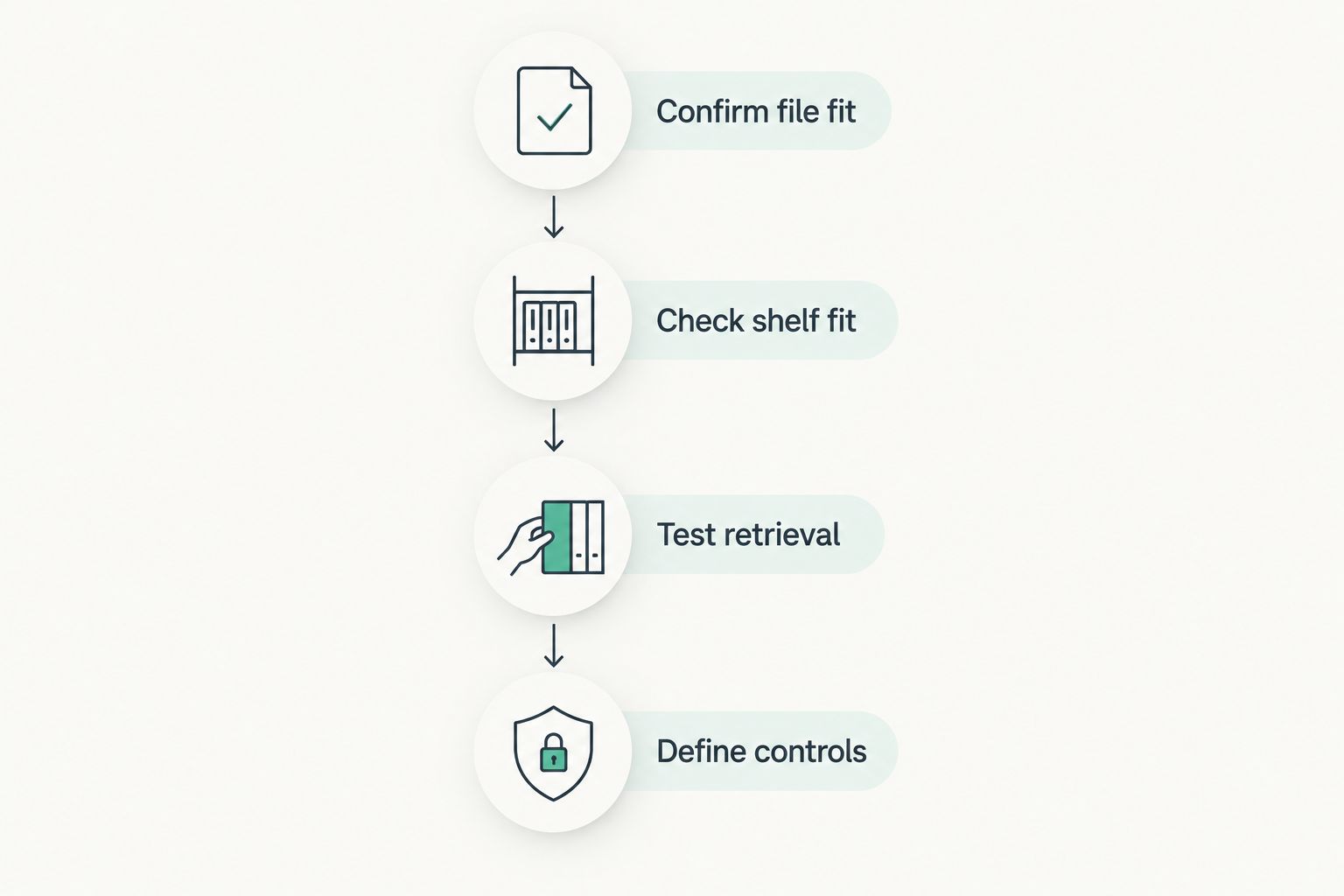
How to approve a box before a bulk order
Pfsupplyco's stated wholesale scope reaches 50,000+ units, so a box-selection error can affect a large purchasing program. Approve the enclosure against a written specification before scaling the order. Keep this 2026 approval sequence focused on the work the box must perform.
Confirm file fit
Load a sample with representative folders, dividers, and tabs. Close it without forcing the contents down. Check whether staff can identify and remove the needed folder without disturbing the whole collection.
Check shelf fit
Place the occupied sample in its intended shelf position. Confirm both closed-box clearance and the space needed for retrieval. Obtain the supplier's handling and stacking guidance rather than improvising a load limit.
Test retrieval
Have the intended users open the box, retrieve a file, return it, and close the enclosure. Observe lid handling and folder interference. Choose the lid format that removes unnecessary work from that sequence.
Define controls
Specify the box identifier, location record, access responsibility, and applicable retention category. Keep sensitive personal details out of labels visible to unauthorized people. Make the location record useful without turning the box exterior into a disclosure risk.
How we ranked these box types
The order prioritizes routine financial-records work, then distinct exceptions. Separate-lid corrugated boxes are the default for shelf storage; attached lids address repeated retrieval; plastic addresses material exposure; archival enclosures address preservation; and locks address controlled access during transfers.
This is a workflow ranking, not a laboratory performance ranking. It makes no strength, seal, or protection-rating claims for unspecified products. Your final choice depends on the exact enclosure's documented specifications and the approval checks above.
Which document storage boxes should you choose?
Choose separate-lid corrugated file boxes as your default for routine shelf-stored records. Switch to attached lids when repeated access makes detached-lid handling inconvenient. Treat moisture exposure, preservation, and controlled transfers as separate requirements that justify different enclosures.
For a 2026 procurement decision, write the requirement before selecting the box: file fit, shelf fit, lid format, material, handling guidance, and records controls. That gives purchasing and records staff the same acceptance standard.
FAQ
What's the best document storage box for a financial institution?
A separate-lid corrugated file box is the default for routine shelf-stored financial records. Choose attached lids for repeated retrieval, and evaluate other materials or closures when moisture, preservation, or controlled transfer changes the requirement.
Are attached-lid boxes better than separate-lid boxes?
Attached-lid boxes are better when keeping the lid connected improves frequent retrieval. Separate-lid boxes let staff remove the top independently; compare the actual workflow rather than assuming either style is stronger.
Does a document storage box make financial records compliant?
A document storage box does not establish compliance. Retention requirements, access controls, location records, and disposition procedures must be managed separately under the requirements applicable to the records.
Are white file boxes stronger than brown file boxes?
Color alone does not establish file-box strength. Compare the exact board construction and documented handling guidance instead of treating white or brown as a performance grade.
Are plastic document boxes waterproof?
Plastic construction alone does not establish waterproof performance. Evaluate the complete enclosure, including its lid, openings, and any documented seal performance.
When should financial institutions use archival boxes?
Use archival boxes when the records have an explicit preservation requirement. Request material specifications for the exact enclosure and assess the storage conditions alongside the box.
What should I check before ordering document boxes in bulk?
Check representative files in a sample box, verify shelf fit, test retrieval, and define records controls. Obtain handling guidance for the exact box before approving a larger order.
One last thing
A box identifier is useful only if it connects to a reliable location record. Before approving the enclosure, ask someone other than the person who packed it to locate a named file using your normal process. That check tests whether your storage system works—not merely whether the paperwork fits.